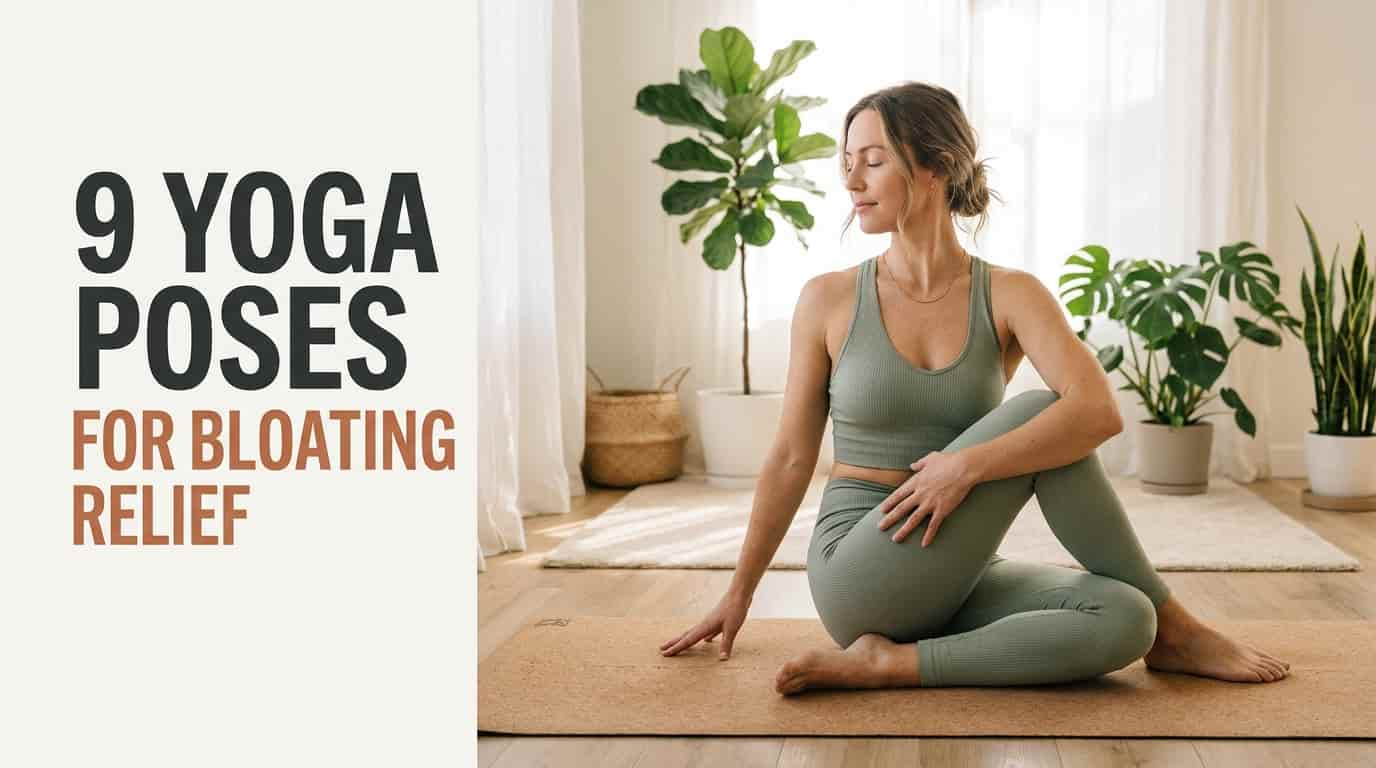
Searching for effective yoga poses for bloating relief usually happens when your waistband feels like a medieval torture device right after dinner. You feel five months pregnant with a food baby, your stomach is tight as a drum, and sitting on the couch is somehow making the pressure worse.
Here is the good news: you don’t need to wait six hours or pop chalky antacids to feel human again:
-
Directional Colon Compression: Specific sequences compress the ascending colon on your right side first, then the descending colon on your left, physically pushing trapped gas toward the exit.
-
Vagus Nerve Activation: Combining gentle spinal movements with slow belly breathing switches your body from “fight-or-flight” into “rest-and-digest” mode within 90 seconds.
-
Increased Mesenteric Blood Flow: Releasing tension in the psoas and abdominal wall rushes fresh, oxygenated blood straight to sluggish digestive organs.
-
Immediate Mechanical Relief: Practicing a targeted 15-minute sequence can reduce abdominal distension and move stubborn gas bubbles in as little as 10 to 15 minutes.
Why Your Stomach Feels Like an Overinflated Balloon (The Gut-Brain Reality)
Bloating isn’t just about eating too much broccoli or sneaking an extra slice of sourdough. Sometimes it happens after drinking a plain glass of water. Why?
It comes down to two distinct culprits: trapped intraluminal gas or sluggish gut motility. When your digestive tract slows down, fermentable carbohydrates sit in your small and large intestines way longer than they should. Your gut bacteria throw a literal feast, producing hydrogen, methane, and carbon dioxide gases that stretch your intestinal walls like a balloon.
But here is the kicker most fitness blogs ignore. Your nervous system runs the entire show.
When you eat while stressed, answering emails, or scrolling through bad news on your phone, your sympathetic nervous system stays locked in overdrive. Cortisol spikes. Blood diverts away from your stomach and rushes to your limb muscles. Your digestive secretions—stomach acid, bile, and pancreatic enzymes—pretty much dry up.
Think about it. Have you ever noticed your stomach balloons up ten times worse during a stressful workweek compared to when you’re lounging on vacation eating pasta? That isn’t a coincidence.
Stress physically paralyzes the smooth muscle contractions of your gut, a wave-like motion known as peristalsis (Source: [PubMed/NIH/Mayo Clinic Study]). Without strong peristalsis, food and gas get stuck in traffic around the sharp bends of your large intestine. If you want to fix your gut long-term,

How Yoga Poses for Bloating Relief Actually Work Inside Your Gut
Skeptical that stretching on your living room rug can actually break up a painful gas bubble? I was too. Years ago, my post-dinner bloat was so miserable I couldn’t even lie flat in bed (and believe me, my energy levels were completely tanked back then from terrible sleep).
Then I learned the biomechanics of visceral manipulation. Using yoga poses for bloating relief isn’t about burning calories or getting flexible hamstrings. It is pure internal plumbing maintenance.
First, gentle postures apply targeted mechanical compression and decompression to your abdominal cavity. When you fold forward or pull your thigh against your belly, you temporarily squeeze the hollow organs of your digestive tract. When you release the pose, fresh blood floods into the mesenteric arteries—what yoga teachers often call the “squeeze and soak” effect.
Second, rotational movements break up large, painful gas pockets into smaller, manageable bubbles. Your colon has two notorious bottlenecks called the hepatic flexure (on the upper right under your ribs) and the splenic flexure (on the upper left). Gas loves to get trapped right in those corners, causing sharp pains that people sometimes mistake for gallbladder or heart issues.
Third, slow yoga movements stimulate the vagus nerve. This massive cranial nerve wanders from your brainstem straight down into your digestive tract, acting as the primary telephone line between your brain and your gut microbiome (Source: [Mayo Clinic Study]). Stimulating the vagus nerve triggers the Migrating Motor Complex (MMC)—your gut’s internal street sweeper that pushes lingering food debris and gas down the pipe.
The Golden Rule of Digestive Yoga: Right Side First, Left Side Second
Stop right here. If you take only one piece of advice from this entire guide, make it this one.
Almost every generic yoga article on the internet tells you to pull a random knee to your chest or twist whichever way feels good. Wrong. Doing your poses in the wrong anatomical order can actually push gas backward against the natural flow of your bowels, leaving you more cramped than when you started.
You must follow the one-way street of your large intestine.
Food matter and gas enter your large intestine at the cecum in your lower right abdomen. From there, it travels UP your right side (the ascending colon), ACROSS your middle just beneath your ribcage (the transverse colon), and DOWN your left side (the descending colon) before exiting through the sigmoid colon and rectum.
So how do we work with this anatomy? You always compress or twist toward your right side first, and your left side second.
By compressing the right side first, you massage the ascending colon and encourage movement upward and across. Following up on the left side massages the descending colon, clearing the runway downward. It is simple physics, and honestly, it changes everything.
9 Best Yoga Poses for Bloating Relief (Step-by-Step Protocol)
Forget turning yourself into a human pretzel. When your belly is distended and tender, aggressive backbends or intense core crunches will only make you nauseous. Grab a thick yoga mat, a throw pillow or yoga block, and move through these nine targeted postures slowly.
1. Wind-Relieving Pose (Pawanmuktasana)
In Sanskrit, Pavana means wind and Mukta means to release or liberate. Yep, ancient yogis literally named this posture the “fart pose,” and it holds the crown as the single most reliable movement among all yoga poses for bloating relief.
-
Why It Works: It isolates the ascending colon on the right, then the descending colon on the left, before compressing the transverse colon across the center. It also flattens the lumbar spine, soothing the lower back ache that often tags along with severe gas.
-
How to Do It: Lie flat on your back with both legs extended long on the mat. Inhale deeply. As you exhale, bend your right knee and pull it snugly toward your right ribs, interlacing your fingers just below the kneecap. Keep your left calf heavy on the floor. Hold here for 6 to 8 slow, deep belly breaths. Release the right leg long, then repeat on the left side for 6 to 8 breaths. Finally, draw both knees into your chest together, wrapping your forearms around your shins, and rock gently from side to side for 5 breaths.
-
Modification for Sensitive Bellies: If hugging your shins creates too much pressure on your stomach or pinches your hip flexors, hold the backs of your thighs (your hamstrings) instead. Keep your head and shoulders resting flat on the floor—don’t strain your neck by curling your nose to your knees.

2. Supine Spinal Twist (Supta Matsyendrasana)
Once you have compressed the colon vertically in Wind-Relieving Pose, it is time to wring it out gently like a wet washcloth.
-
Why It Works: This supine rotation massages the internal organs laterally and opens up the tight corners of the hepatic and splenic flexures where gas bubbles love to hide. Because you are lying down, your abdominal wall can stay completely soft while gravity does the heavy lifting.
-
How to Do It: Lying on your back, hug your right knee into your chest. Extend your right arm straight out to the side on the floor like a T, palm facing up. Using your left hand, gently guide your right knee across your body toward the floor on your left side. Let your gaze fall softly over your right shoulder. Breathe deeply into the exposed right side of your ribcage and belly for 8 slow breaths, then switch sides.
-
Pro Tip: Don’t force your knee to touch the floor if it causes your opposite shoulder blade to pop up in the air. Shove a thick pillow or folded blanket underneath your bent knee so your torso can truly melt into the twist.
3. Wide-Kneed vs. Closed-Kneed Child’s Pose (Balasana)
Most instructors teach Child’s Pose with the knees wide apart. That feels great on the hips, sure, but we need to tweak it depending on how painful your stomach feels right now.
-
Why It Works: Folding your torso over your thighs creates a gentle, sustained internal massage every time you inhale and expand your belly against your legs. It also down-regulates the sympathetic nervous system almost instantly.
-
How to Do It: Kneel on your mat and bring your big toes to touch behind you. If your belly is mildly bloated, keep your knees about hip-width apart so your stomach rests directly on top of your thighs as you fold forward. If your stomach is painfully distended or cramping, spread your knees as wide as the edges of your mat to give your belly room to hang freely without compression. Rest your forehead on the floor (or a pillow) and stretch your arms forward or drape them back by your feet. Stay here for 1 to 2 minutes, focusing on pushing your lower back ribs up toward the ceiling with every inhale.
4. Dynamic Cat-Cow Flow (Marjaryasana-Bitilasana)
Sitting at a desk all day folds your digestive tract in half like a kinked garden hose. Cat-Cow unkinks the hose.
-
Why It Works: Alternating between spinal extension and spinal flexion rhythmically stretches and contracts the tissues of your abdominal wall and peritoneum. This pumping action wakes up sluggish peristalsis and increases circulation to the enteric nervous system.
-
How to Do It: Start on your hands and knees in a tabletop position—wrists stacked directly under your shoulders, knees directly under your hips. On an inhale, drop your belly softly toward the mat, lift your sit bones toward the ceiling, and draw your chest forward through your upper arms (Cow Pose). Feel the front of your stomach lengthen. On an exhale, press firmly into your palms, round your upper back toward the ceiling like an angry Halloween cat, and let your head drop heavy (Cat Pose). Move slowly through 8 to 10 rounds, matching every movement to a full breath.
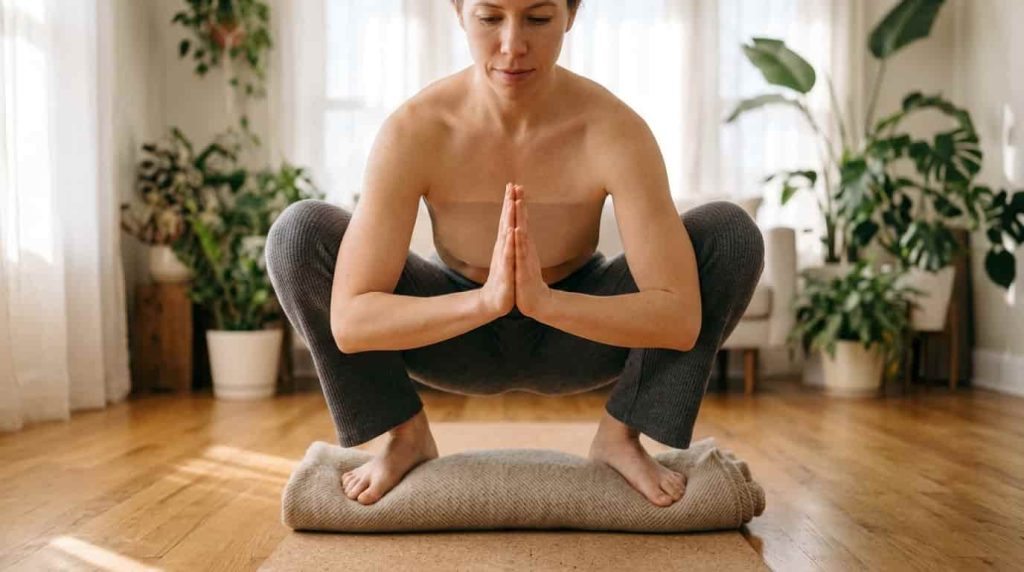
5. Garland Pose / Yogi Squat (Malasana)
Let’s talk about bathroom mechanics for a second. Modern western toilets put our bodies at a 90-degree angle, which literally pinches the puborectalis muscle around the lower colon like a lasso.
-
Why It Works: Squatting deeply changes the anorectal angle, completely relaxing the pelvic floor and putting natural physical pressure on the ascending and descending colon using your own inner thighs. If your bloating is backed up by mild constipation, , because Malasana is your best friend.
-
How to Do It: Stand with your feet slightly wider than hip-width apart, turning your toes outward at a 45-degree angle. Bend your knees and lower your hips all the way down into a deep squat. Bring your palms together in prayer position at the center of your chest and press your elbows gently against your inner knees to lengthen your spine. Drop your tailbone heavy toward the floor and breathe into your pelvic bowl for 8 to 10 breaths.
-
Crucial Prop Modification: If your heels pop up off the floor or your ankles feel like they’re screaming, do NOT hang out on your tiptoes—that creates tension in your pelvic floor. Roll up the back edge of your yoga mat or slide a folded towel underneath your heels so you have a solid base to rest on. You can also sit your hips directly onto a stack of two yoga blocks.
6. Happy Baby Pose (Ananda Balasana)
Yes, you feel a little ridiculous doing this one if someone walks into the room. Do it anyway.
-
Why It Works: Happy Baby combines the benefits of a deep squat (Malasana) with the nervous-system relaxation of lying flat on your back. It opens the pelvic floor, releases trapped tension in the deep hip rotators and psoas, and gently compresses the sides of the abdomen without crushing the center of your stomach.
-
How to Do It: Lie flat on your back and draw both knees toward your chest. Open your knees wider than your ribcage, pulling them toward your armpits. Flex your feet so the soles face straight up toward the ceiling, stacking your ankles directly over your knees. Grab the outer edges of your feet (or your ankles/shins if reaching your feet pulls your tailbone off the floor). Rock lazily from side to side like a content baby for 60 seconds, massaging your sacrum and lower back into the mat.
7. Gentle Sphinx Pose (Salamba Bhujangasana)
Wait—why is a belly-down backbend on this list? Competitors often recommend full Bow Pose (Dhanurasana), where you lie on your stomach and yank on your ankles. Honestly, doing Bow Pose when you have a massive gas bubble feels like lying on a bowling ball. Sphinx Pose is the smarter, gentler upgrade.
-
Why It Works: Lying prone on your stomach provides gentle, even counter-pressure across the entire front abdominal wall while stretching out tight fascia around the stomach and small intestine. It creates space in the upper abdomen—right where indigestion and upper-belly bloat sit.
-
How to Do It: Lie flat on your stomach with your legs extended back, hip-width apart, tops of the feet resting on the mat. Prop yourself up on your forearms, stacking your elbows directly underneath your shoulders with your forearms parallel like a sphinx. Press gently into your forearms to lift your chest forward and up, keeping your lower belly and pelvis heavy on the floor. Soften your glutes completely. Take 6 slow breaths, feeling your front belly press against the mat with every inhale.
8. Seated Spinal Twist (Ardha Matsyendrasana)
When you can’t lie down on a dirty floor (or you’re trying to relieve bloating shortly after eating when lying flat might trigger heartburn), a seated twist gets the job done upright.
-
Why It Works: Sitting tall keeps your esophagus elevated while the rotational torque of your torso squeezes the liver, pancreas, and intestines.
-
How to Do It: Sit on the floor (or on the edge of a folded blanket) with both legs extended straight in front of you. Bend your right knee and step your right foot across the outside of your left thigh, planting your right foot flat on the floor. Keep your left leg straight (or bend it comfortably underneath you if your hips allow). Place your right fingertips on the floor behind your tailbone like a kickstand. Inhale and reach your left arm up to lengthen your spine; exhale and hook your left elbow around your right knee, twisting toward the right. Remember our rule: twist to the right first (compressing the right side), hold for 6 breaths, then switch legs and twist to the left.
9. Legs-Up-the-Wall Pose (Viparita Karani)
If your bloating comes with heavy legs, water retention, PMS swelling, or pure exhaustion at the end of a long day, this restorative gem is non-negotiable.
-
Why It Works: Flipping gravity in this mild inversion drains pooled lymph and venous blood from your lower extremities back toward your core, easing pelvic congestion. More importantly, it drops your heart rate and flips your nervous system into deep parasympathetic recovery faster than almost any other posture on earth.
-
How to Do It: Sit sideways right next to an open wall with one hip touching the baseboard. In one smooth motion, swing your legs up the wall as you lower your upper back and head flat onto the floor. Your sit bones don’t have to be glued to the wall—scoot a few inches away if your hamstrings feel tight. Rest your arms out to your sides with your palms facing up, close your eyes, and stay here for 5 to 10 minutes.
The 15-Minute “Deflate Your Belly” Sequence (Morning vs. Evening)
Knowing individual yoga poses for bloating relief is great, but stringing them together in the right physiological sequence is what actually moves the needle. Depending on when your bloat hits, follow one of these two targeted flows.
The Evening Post-Dinner Gas Relief Flow (15 Minutes)
Wait at least 45 to 60 minutes after finishing a heavy meal before lying flat, or start with the upright postures first if you are prone to acid reflux:
-
Minutes 0–3: Dynamic Cat-Cow Flow. Start on hands and knees to mobilize the spine and wake up gut motility without squishing a full stomach.
-
Minutes 3–5: Wide-Kneed Child’s Pose. Sink your hips back, rest your forehead down, and establish slow, 4-second inhales and 6-second exhales.
-
Minutes 5–8: Wind-Relieving Pose (Right, Left, then Both). Roll onto your back. Hug the right knee in for 60 seconds, then the left knee for 60 seconds, then both knees together for 60 seconds.
-
Minutes 8–10: Supine Spinal Twist. Guide the right knee across to the left for 60 seconds, then switch and guide the left knee across to the right for 60 seconds.
-
Minutes 10–15: Legs-Up-the-Wall Pose. Finish by swinging your legs up the wall, placing your hands on your belly, and letting your digestive system take over.
The Morning “Sluggish Gut & Constipation” Wake-Up Flow (10 Minutes)
Wake up feeling puffy and backed up from the night before? Drink a warm glass of water with a pinch of sea salt or lemon, then hit the mat on an empty stomach:
-
Minutes 0–2: Gentle Sphinx Pose. Lengthen the front belly and stimulate circulation to the upper digestive organs.
-
Minutes 2–5: Seated Spinal Twist (Right then Left). Wring out the midsection while sitting tall to trigger the gastrocolic reflex.
-
Minutes 5–8: Garland Pose (Yogi Squat). Drop into your deep squat (using a rolled blanket under the heels if needed) and breathe deeply into your pelvic floor to encourage a morning bowel movement.
-
Minutes 8–10: Happy Baby Pose. Lie back, grab your feet, and rock side to side to release any lingering lower abdominal tightness.
Breathwork (Pranayama) That Doubles Your Digestive Speed
Here is a secret most yoga teachers won’t tell you: you can hold the most picture-perfect yoga posture on Instagram, but if you are shallow-breathing into your chest while holding your stomach in tight, your bloating won’t budge an inch.
Zero. Not a bit.
Think about the anatomy of your diaphragm. This dome-shaped muscle sits right beneath your lungs, resting directly on top of your liver and stomach. When you take a true diaphragmatic “belly breath,” the diaphragm contracts and pushes downward toward your pelvis.
That downward push creates a gentle, rhythmic piston effect that physically massages your stomach and intestines from above. At the exact same time, slow exhalations stimulate the vagus nerve, telling your pyloric and ileocecal valves to relax and open up
While holding any of the yoga poses for bloating relief listed above, pair the posture with 4-6 Diaphragmatic Breathing:
-
Unclench your jaw and consciously let your belly hang out—stop sucking your stomach in!
-
Inhale slowly through your nose for a count of 4 seconds, intentionally inflating your lower belly like a balloon so it presses outward against your thighs or waistband.
-
Exhale slowly and smoothly through your nose (or softly pursed lips) for a count of 6 seconds, letting your navel sink naturally back toward your spine.
-
Extending the exhale longer than the inhale is the biological cheat code that flips your nervous system into parasympathetic “rest-and-digest” mode.

Crucial Troubleshooting: When Yoga Makes Bloating Worse
Wait—can yoga actually make your stomach hurt more? Yes, if you ignore a few basic digestive mechanics. If you jumped on the mat and felt nauseous or crampy, check these four common mistakes:
-
Mistake #1: Practicing Deep Belly Compression Immediately After a Huge Meal. If you just ate a giant bowl of pasta ten minutes ago, your stomach is physically full of food and liquid chime. Dropping straight into a closed-kneed Child’s Pose or lying flat on your stomach will push gastric acid straight up your esophagus. If you need relief right after eating, stick to upright seated twists, a gentle 10-minute walk, or sitting in Thunderbolt Pose (Vajrasana—kneeling upright on your shins) for the first 30 minutes.
-
Mistake #2: Bracing Your Core Like You’re in a Pilates Class. So many of us have been trained to “engage our core” and pull our belly button to our spine whenever we step onto an exercise mat. During digestive yoga, bracing your rectus abdominis traps gas in place. Let your belly be completely soft and pudgy while you stretch.
-
Mistake #3: Ignoring Acid Reflux (GERD) or Hiatal Hernia Triggers. If you struggle with reflux, inversions like Downward-Facing Dog or even Legs-Up-the-Wall right after dinner can cause regurgitation. Prop your upper back and head up on an inclined bolster or two pillows when doing supine poses like Wind-Relieving Pose.
-
Mistake #4: Confusing Chronic Clinical Conditions with Simple Trapped Gas. Yoga is phenomenal for functional bloating, aerophagia (swallowing air), and stress-induced gut slowdowns. However, if you wake up with a flat stomach every morning and look six months pregnant by 4:00 PM regardless of what you do, or if your bloat comes with chronic diarrhea, constipation, or brain fog, you might be dealing with SIBO (Small Intestinal Bacterial Overgrowth), food intolerances, or endometriosis. If you suspect a deeper microbiome issue,
Beyond the Mat: Dietary Tweaks and Natural Remedies to Stop the Swell
Using yoga poses for bloating relief will bail you out when you’re already uncomfortable, but pairing your movement routine with a few smart kitchen habits will stop the ballooning before it even starts.
-
Sip Warm Carminative Herbal Teas: Ditch the ice-cold sparkling water with meals—carbonation literally injects gas bubbles into your tract, and ice-cold liquids constrict blood vessels in the stomach. Instead, brew a hot mug of peppermint, ginger, or crushed fennel seed tea 20 minutes after eating. Peppermint acts as a natural antispasmodic that relaxes smooth muscle tissue in the gut wall, while ginger accelerates gastric emptying.
-
Activate Your Cephalic Phase of Digestion: Digestion doesn’t start in your stomach; it starts in your brain and mouth. When you chew each bite 20 to 30 times until it is nearly liquid, salivary amylase begins breaking down starches before they ever hit your gut. Plus, eating slowly keeps you from gulping down excess air (aerophagia).
-
Watch Sneaky FODMAP Triggers and Sugar Alcohols: Have you been chewing “sugar-free” gum or eating protein bars loaded with erythritol, xylitol, Chicory root fiber (inulin), or sorbitol? Those sugar alcohols and prebiotic fibers are notorious for fermenting rapidly in the colon, creating massive gas pockets within an hour.
-
Take a 10-Minute Post-Meal Stroll: Before you roll out your yoga mat later in the evening, take a casual 10-minute walk around the block right after dinner. Walking stimulates gentle mechanical peristalsis and stabilizes post-meal blood sugar spikes without putting premature compression on a full stomach.
Read: How to Relieve Heartburn Instantly at Night: 9 Tips That Actually Help
Frequently Asked Questions (FAQ)
How long does it take for yoga poses for bloating relief to actually work?
Most people feel noticeable abdominal decompression and begin passing trapped gas within 10 to 15 minutes of practicing a targeted sequence. The key is holding each posture for at least 5 to 8 slow, diaphragmatic breaths rather than rushing through the movements, allowing the smooth muscle of your intestines time to relax and release spasms.
Which single yoga pose gets rid of trapped gas the fastest?
Wind-Relieving Pose (Pawanmuktasana) combined with Garland Pose (Malasana/Yogi Squat) is the fastest one-two punch for immediate gas release. Wind-Relieving Pose physically pushes trapped air through the ascending and descending colon while you lie relaxed on your back, while the deep Yogi Squat opens the pelvic floor and straightens the lower anorectal angle so gas can exit effortlessly.
Should I do yoga for bloating right after eating a heavy meal?
No, you should avoid lying flat on your back or folding tightly over your stomach for at least 45 to 60 minutes after a heavy meal to prevent acid reflux and indigestion. Immediately after eating, stick to gentle upright postures like kneeling in Thunderbolt Pose (Vajrasana), practicing a light Seated Spinal Twist, or taking a slow 10-minute walk until the initial heavy stage of stomach digestion settles.
Why do I always fart during yoga class?
Passing gas during yoga happens because combining deep belly breathing with twisting and hip-opening postures activates your parasympathetic nervous system while mechanically squeezing your large intestine. As your pelvic floor muscles and internal sphincters finally let go of daily stress tension, any trapped air pockets get pushed right out—which means the poses are doing their exact job!
Dealing with a tight, swollen stomach at the end of the day doesn’t have to ruin your evening or wreck your sleep. By respecting your gut’s natural right-to-left anatomy and pairing slow belly breaths with these targeted yoga poses for bloating relief, you can manually switch your digestive system back online whenever it stalls out. Roll out your mat tonight, hug that right knee in first, let your belly hang completely soft, and give your gut the space it needs to finally breathe.
Medical Disclaimer: Look, before we roll out the mat, let’s get the legal stuff out of the way. I am a passionate health and wellness writer, not your personal gastroenterologist. The movements, breathwork, and dietary strategies shared in this guide are for educational purposes only and shouldn’t replace professional medical advice. If you’re dealing with severe abdominal pain, sudden unexplained weight loss, fever, or chronic digestive distress, please consult a qualified healthcare provider before trying any new physical routine.