A well-designed bicycle workout for weight loss can help you burn calories, improve cardiovascular fitness, and exercise with less joint impact than many running-based workouts.
Practice outdoors, cycle on a stationary bike or combine biking (or another kind of cardio) with body weight workouts for an total exercise.
Cycling alone is not enough to losing weight. Results are very much dependent upon total calories consumed, consistency with training, recovery, and how slowly you progress.
The essentials of the best cycles workouts, how often to train — plus a full-body workout for 45 minutes and a four-week plan for beginners
Can Cycling Help You Lose Weight?
Cycling raises energy expenditure, which may facilitate the calorie deficit conducive to weight loss. When you burn more calories than your body consumes, it utilizes energy stored in the body.
The number of calories you burn is based upon:
- Body weight
- Riding speed
- Resistance
- Terrain
- Workout duration
- Fitness level
- Overall effort
An intense interval ride will use far more calories per minute than a gentle one, but extended moderate rides can rack up plenty of weekly activity regardless.
This is why the worst thing you can do is one punishing session. It is a pattern you can do over and over.
Why Cycling Works Well for Beginners
Cycling is a low-impact activity, as the bike supports the body weight. It typically puts less stress on the knees, hips and ankles than running or jumping workouts.
You can quickly adjust the difficulty by altering your speed, resistance, road, or how long you exercise. This makes cycling suitable for new riders to riding or people who are returning from exercise.
It also holds borderline daily life easy to access. Ride for transportation, run errands by bike or take to a stationary bike at home.
What Muscles Does Cycling Work?
Cycling primarily cramps the lower half.
The vast majority of that force you apply during the downward portion of the pedal stroke comes from your quads. Power Generation : During hills, sprints and high resistance effort the gluts and hamstrings contribute to generation of power.
The lower legs are stabilized by the calves, and the hip flexors assist as the pedals rise. Your burning torso is necessary to keep you steady (and pedal well).
Also, cycling does not offer much resistance for the chest, back, shoulders and arms. Incorporating pushups, rows, planks or triceps also improves workout balance between agonist-antagonist muscles.

How Often Should You Cycle for Weight Loss?
For beginners, 3 rides per week is often a good starting point. That is enough to become fit without too much fatigue.
You can do 4 or 5 sessions when you feel your stamina ready. Not all of those rides need to be a workout.
- A balanced week may include:
- One or two steady rides
- One interval session
- One hill or resistance workout
- One longer easy ride
- At least one recovery day
You need both hard workouts to improve fitness, and easy sessions (including rest days) so that you recover well enough to continue training.
How Long Should Each Ride Be?
Best Bicycle Workouts for Weight Loss
Your body adapts when every ride uses the same pace and resistance. Mixing several workout types creates a stronger training effect and reduces boredom.

Steady-State Beginner Ride
This is an easy recovery workout that builds aerobic fitness.
Workout:
- 5 minutes of easy cycling
- 20 to 30 minutes at moderate intensity
- 5 minutes of easy cycling
The main part of the workout should leave you breathing harder but still able to talk in short sentences.
Perform this workout two to three times per week. Once it gets easy, add 5 minutes before you increase your intensity!
High-Intensity Interval Workout
Intervals alternate hard efforts with easy recovery periods. They allow you to complete a demanding workout in less time.
Workout:
- 5-minute warm-up
- 30 seconds hard
- 90 seconds easy
- Repeat 8 to 10 times
- 5-minute cooldown
The hard efforts should feel challenging but controlled. Do not sprint so aggressively that your hips bounce or your posture collapses.
One interval session per week is enough for most beginners. More experienced riders may complete two.
Hill or Resistance Workout
Hill runs build leg strength and boost your heart rate. These include a gradual climb for outdoor riders or increasing resistance for indoor riders.
Workout:
- 5-minute warm-up
- 1-3 minutes climbing or very heavy resistance
- 2-3 minutes of easy pedaling
- Repeat 5 to 8 times
- 5-minute cooldown
Maintain relaxed upper body and a fluid pedal stroke. It should demand some effort from you without making the ride feel like a never-ending slog through molasses.
Long, Easy Endurance Ride
Breaks up a week of activity without repeating tiring interval sessions —a longish low-intensity ride means more overall exercise.
Ride for 45 to 75 minutes at a comfortable pace You should be able to keep it up without gasping for breaths.
Keep the session controlled. A long day shouldn’t suddenly become a full-on race.
45-Minute Full-Body Bicycle Workout for Weight Loss
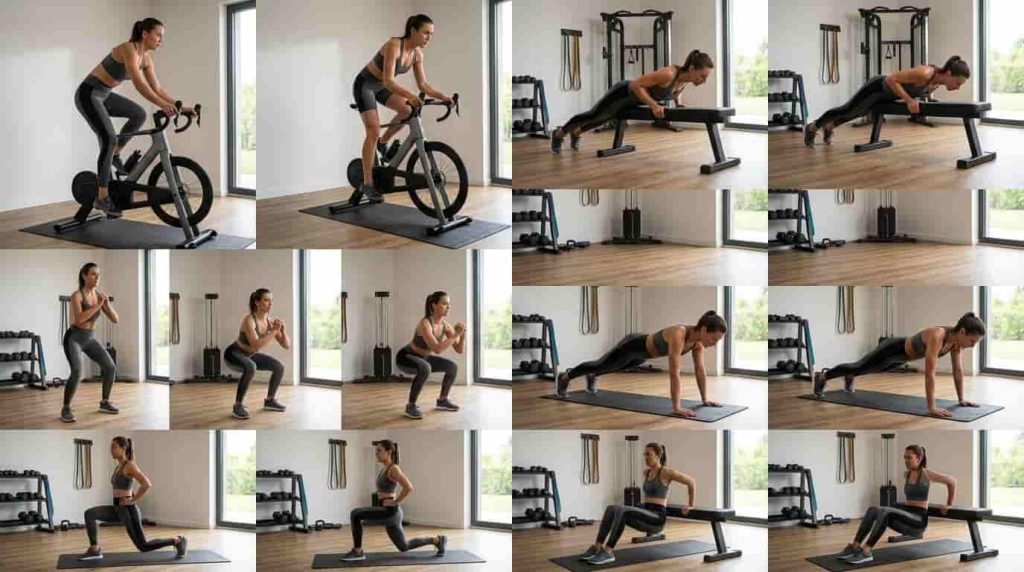
The workout combines bike intervals and bodyweight exercises. In a single lesson it trains your legs, upper body, core and the cardiovascular system.
You will need:
- Stationary Bike or Bicycle Trainer
- A stable chair or bench
- Adequate space to safely exercise
For beginners, it is possible to shorten the rounds or take longer recovery times.
Warm-Up: 6 Minutes
For each movement do it for 30 seconds:
- Shoulder swings
- Forward shoulder circles
- Backward shoulder circles
- Bodyweight good mornings
- Alternating reverse lunges
- Marching in place
Which then rotates easily for 3minutes. In the last minute start to increase your speed
Round 1: Cycling Intervals
Complete once:
- 60 seconds hard cycling
- 60 seconds easy cycling
- 60 seconds hard cycling
- 60 seconds easy cycling
- 30 seconds hard cycling
- 30 seconds easy cycling
Rest for 60 seconds.
The easy pedaling periods are active recovery. They lower the intensity while keeping your legs moving.
Round 2: Upper Body and Core
Complete three to five rounds:
- 30 seconds push-ups
- 30 seconds bicycle crunches
- 30 seconds rest
If basic push-ups are too difficult, switch to wall or incline push-ups.
With bicycle crunches, your torso should rotate and you don’t want to pull on your neck.
Round 3: Cycling Intervals
Repeat:
- 60 seconds hard cycling
- 60 seconds easy cycling
- 60 seconds hard cycling
- 60 seconds easy cycling
- 30 seconds hard cycling
- 30 seconds easy cycling
Rest for 60 seconds.
Pick a resistance that feels challenging but not enough to have you bouncing in the seat.
Round 4: Lower Body and Core
Complete three to five rounds:
- 30 seconds bodyweight squats
- 30 seconds plank shoulder taps
- 30 seconds rest
Squat Get your chest out and push your hips back. The knees should move in the same direction as the toes.
Widen stance to avoid unwanted rotation of hip on shoulder taps.
Round 5: Final Cycling Intervals
Complete:
- 60 seconds hard cycling
- 60 seconds easy cycling
- 60 seconds hard cycling
- 60 seconds easy cycling
- 30 seconds hard cycling
- 30 seconds easy cycling
Rest for 60 seconds.
It starts well but is like your last interval, controlling good posture and pedal stroke.
Round 6: Upper- and Lower-Body Finisher
Complete three rounds:
- 30 seconds triceps dips
- 30 seconds alternating reverse lunges
- 30 seconds rest
Use a sturdy chair or bench for dips. Lower only as far as your shoulders tolerate comfortably.
Reverse lunges are often easier on the knees than forward lunges.
Cooldown and Stretching
Cycle slowly for two to three minutes.
Then hold each stretch for 20 to 30 seconds per side:
- Quadriceps stretch
- Hamstring stretch
- Calf stretch
- Glute stretch
- Chest stretch
- Shoulder stretch
Stretch gently. Stop if you feel sharp pain.
Beginner Modifications
Do not force yourself to complete the maximum number of rounds.
Start with two or three bodyweight rounds. Reduce the hard cycling intervals to 30 or 40 seconds and increase easy pedaling to 90 seconds.
You can also make the exercises easier:
- Use wall or incline push-ups
- Squat to a chair
- Replace bicycle crunches with dead bugs
- Hold a short plank instead of shoulder taps
- Use reverse lunges instead of forward lunges
Good form matters more than completing every repetition.
Four-Week Bicycle Workout Plan for Weight Loss
This plan is specifically for beginners. Adapt the length and intensity to your shape, rest and time schedule.
Immediately discontinue exercise if you develop chest pain, severe dizziness, sharp joint pain or unusual shortness of breath.

Week 1: Build Consistency
- Monday: 20-minute easy ride
- Tuesday: Rest or light walking
- Wednesday: 25-minute steady ride
- Thursday: Rest
- FRIDAY: 20 mins of riding [4 x 20 sec faster]
- Saturday: Optional mobility work
- Sunday: 30-minute relaxed ride
Keep the resistance light. Leave each workout relatively fresh and, in your mind at least, could have gone on for a few minutes more.
Week 2: Increase Duration
- Monday: 30-minute steady ride
- Tuesday: Rest
- Wednesday: 25 min ride with six 3-min intervals
- Thursday: Easy walk or mobility work
- Friday: 30-minute steady ride
- Saturday: Rest
- Sunday: 35-minute easy ride
Increase the workload gradually. Do not increase duration and intensity at the same time in an aggressive manner.
Week 3: Add Intensity
- Monday: 30-minute steady ride
- Tuesday: Strength training or rest
- Wednesday: 25-minute interval workout
- Thursday: Recovery day
- Friday: 30-minute hill or resistance ride
- Saturday: Rest
- Sunday: Easy ride — 40 to 45 minutes
Harder workouts may increase hunger. It is better to plan meals than a hasty recovery with high calorie food à la post-training.
Week 4: Add a Full-Body Session
- Monday: 35-minute moderate ride
- Tuesday: Rest
- Wednesday: 25-30 min interval session
- Thursday: Rest day, easy walk or mobility work
- Friday: Full Body Cycle (35-45 minutes cycling circuit)
- Saturday: Rest
- Sunday – 45- to 60-minute steady endurance ride
Summary at the end of the week: monitor your energy, sleep, soreness and motivation. Cut back the workload if fatigue is increasing rather than decreasing.
Indoor vs. Outdoor Cycling
They both have the potential to aid weight loss [83, 84].
The stationary bike provides consistent resistance, simple to monitor intervals and shields you from inclement weather. Another plus is that it is especially safe for unbridled training as you do not have to worry about traffic or road situations.
Outdoor cycling offers more variety. A little more may also be between longer routes than you may encounter hills, wind and the landscape.
Outdoor riding can also replace short car trips and increase your daily activity without requiring a separate workout.
Many riders use both: indoor cycling during the week and outdoor rides on weekends.
Nutrition for Cycling and Weight Loss
Cycling burns calories, but it cannot compensate for consistently overeating.
Calorie estimates on exercise machines and fitness watches are often imprecise. Use them as rough guides, not permission to eat back every calorie displayed.
Build Balanced Meals
At each meal include a source of protein:
- Chicken
- Fish
- Eggs
- Greek yogurt
- Beans
- Tofu
- Lean meat
In moderation, add vegetables, fruit, whole grains and healthy fats.
Protein supports muscle repair. Rich in fiber foods may assist suppress hunger between meals.
Stay Hydrated
Drink water before and after your ride. Carry water during longer sessions or hot-weather rides.
Electrolyte drinks may be useful during prolonged, intense, or very hot workouts. They are rarely necessary for a short, easy indoor session.
Do Not Train on an Extreme Calorie Deficit
Aggressive calorie restriction can reduce performance, increase hunger, and make recovery harder.
A moderate, sustainable approach is more likely to preserve energy and help you remain consistent.
Recovery Matters
Training creates fatigue. It is during recovery that your body adapts.
Be sure to include in one or two easier days per week. Never schedule demanding interval workouts back to back days
Sleep should be your priority, in addition to listen carefully with a persistent urge for warning signals which is included (but are not limited) the following:
- Declining performance
- Poor sleep
- Irritability
- Heavy legs
- Unusual soreness
- Loss of motivation
These symptoms can occur because you need a bit more rest, food or just a light training week.
Common Mistakes That Slow Progress
Riding at the Same Intensity Every Day
Your body adapts to repeated workouts. The same 20-minute ride at the same resistance will eventually become less challenging.
Progress by adjusting one variable at a time:
- Duration
- Resistance
- Speed
- Interval count
- Weekly frequency
Starting Too Hard
A workout does not need to leave you exhausted to be effective.
Starting too aggressively often leads to soreness, poor recovery, and missed workouts. Begin with a workload you can repeat.
Ignoring Upper-Body Training
Primary, cycling is a lower body workout. Throw in some push-up variations, rows, overhead presses and core work for a more well-rounded program.
Either after your cycling, or in a circuit.
Confusing Active Recovery With Rest
Active recovery is pedaling easy in between hard efforts. It also allows you to recover without sacrificing movement of your legs.
Resting completely is better done in the breaks or when your breathing becomes so overly elevated that continuing would become unsafe.
Tracking Only Body Weight
Food and water intake, sodium, hormones and digestion all affect body weight from day to day.
Track other signs of progress:
- Waist measurement
- Workout duration
- Resistance level
- Average pace
- Resting heart rate
- Energy
- Clothing fit
Bike Setup and Safety
A well-adjusted bike is major advantage over another poorly adjusted bike can often result in excess discomfort.
Adjust the seat height so that your knee is only just straight when the pedal is at its lowest point. Set the handlebars so that you can comfortably reach them and do not round or stretch too much.
For outdoor rides:
- Wear a properly fitted helmet
- Use front and rear lights
- Wear visible clothing
- Follow traffic laws
- Plan safer routes
- Vehicles, pedestrian traffic and road hazards
Outdoors, find a stable chair or bench on dry ground.
Frequently Asked Questions
How about 30 minutes of cycling a day for weight loss?
Cycling for at least 30 minutes can help lose weight with calories control in addition to exercises regularly.
Once your fitness progresses, add resistance, duration or intensity (you can progressively add up new tools) to the workout so that it yields a certain level of challenge.
Does Cycling Reduce Belly Fat?
Cycling is an effective way to decrease overall body and stomach fat levels. You have no say in which area of the body that fat burns from.
Core exercises such as crunches and planks strengthen the abdominal muscles but do not specifically burn belly fat.
What are the benefits of using a Stationary Bike to Lose weight?
Yes. Depending on the model: you can do steady rides, intervals, resistance exercises and endurance training.
That makes it a little more convenient and could lead to better training consistency.
Is Cycling a Full-Body Workout?
Cycling works the lower body in large. Putting together pushups, rows, squats, lunges, plank and triceps exercises makes for a fuller body workout.
Should You Cycle Every Day?
Advanced riders might repeat this weekly by alternating hard and easy rides.
Hitting our initial goals at least requires one or two full recovery days every week for beginners. Daily high-intensity cycling is unnecessary.
Cycling Vs Walking: Cycling More Walk To Lose Weight?
After all, a higher intensity means cycling is burning more calories per minute. You use less equipment to walk and so may find it easier to keep doing regularly.
Choose the right one that you can do safely, and on a regular basis with enough effort involved to help support your goals.
Final Thoughts
Do three rides a week to get going. Establish your duration, followed by intervals, then resistances and up to long ones.
Cycling is only one part; pair it with well-balanced nutrition, physical strength training sessions, sleep and recovery schedule. Stay away from unreasonable exercises and diets that you are unable to maintain.
Even the perfect plan that you quit in a week will do less for you than the simple one you stick to.
More Tips: Bacon Diet: Can You Really Lose Weight Eating Bacon?
Medical disclaimer: This article contains general information about medical conditions and treatments. Before beginning any new exercise or weight-loss program, particularly if you are at risk for heart disease, have joint problems a chronic medical condition or if you have been inactive for a long period of time please consult with your doctor.
Please wait to go to the next post: 30 seconds
Go to Next Post