Have you ever eaten what looked like the freshest salad, congratulated yourself for making a healthy choice, and then spent the next week wondering why your stomach suddenly declared war on you?
I have.
Not because of Cyclospora cayetanensis, thankfully. But after dealing with a nasty foodborne illness years ago, I learned something that completely changed the way I think about fresh produce. We often worry about bacteria like Salmonella or E. coli. Hardly anyone talks about parasites hiding on leafy greens or herbs.
That’s exactly why this topic deserves attention.
Cyclospora cayetanensis is tiny. You can’t see it. You can’t smell it. You definitely can’t taste it. Yet every summer it quietly causes outbreaks that affect hundreds of people across the United States and Canada.
The frustrating part?
Many people assume they have “just a stomach bug.” Others think they caught food poisoning that should disappear in a day or two. Then the diarrhea eases up…only to come roaring back a few days later.
That relapsing pattern is one of the biggest clues pointing toward cyclospora disease, also known as cyclosporiasis.
Here’s the deal.
Understanding this parasite isn’t about creating fear around healthy foods. It’s about helping you recognize the warning signs early, knowing when to ask for the right medical tests, and avoiding weeks of unnecessary misery.
Over the next few minutes, I’ll explain everything in plain English. No confusing medical jargon. Just practical information you can actually use.
What Is Cyclospora cayetanensis?
Let’s start with the basics.
Cyclospora cayetanensis is a microscopic single-celled parasite that infects the small intestine.
Once inside your digestive tract, it interferes with your body’s ability to absorb nutrients and water properly. That’s why people often experience prolonged watery diarrhea and dramatic fatigue instead of a quick 24-hour stomach upset.
Unlike many bacteria responsible for food poisoning, this parasite behaves differently.
It has a life cycle.
It has timing.
And it has a habit of making people believe they’re getting better before symptoms suddenly return.
Doctors call the illness cyclosporiasis.
Although the parasite has existed for decades, public health agencies continue to monitor seasonal spikes because outbreaks still occur almost every year. During the summer of 2026, health officials investigated an unusually large outbreak involving more than 170 confirmed cases in Michigan within a little over a week, while additional domestic cases appeared across several states.
That tells us something important.
You don’t have to travel overseas to become infected.
Fresh produce purchased from your neighborhood grocery store can sometimes be the source.

Why This Parasite Is Different From Ordinary Food Poisoning
When most people hear “food poisoning,” they expect vomiting for a day or two before bouncing back.
Cyclospora disease doesn’t usually follow that script.
Actually, it’s far sneakier.
After swallowing contaminated food or water, symptoms usually don’t appear immediately.
The average incubation period is about seven days.
Sometimes symptoms begin after only two days.
Sometimes it takes nearly two weeks.
That delay makes it surprisingly difficult for people to connect their illness to the meal that caused it.
Imagine eating a fresh salad at a company picnic.
A full week later you’re suddenly running to the bathroom ten times a day.
Would you connect those events?
Most people wouldn’t.
That’s exactly why investigators often spend weeks tracing outbreaks back to a single contaminated shipment of herbs or berries.
Another thing that surprises people is how stubborn this infection can be.
Without proper cyclosporiasis treatment, symptoms may continue for several weeks.
Sometimes even longer.
The parasite keeps irritating the intestinal lining while your body struggles to clear it.
The strange “I’m better…wait, I’m not” cycle
One characteristic makes Cyclospora cayetanensis especially frustrating.
Symptoms often come and go.
You might experience severe diarrhea for several days.
Then everything seems normal.
You start eating regular meals again.
Maybe you even go back to work.
Then suddenly…
The diarrhea returns.
The cramps come back.
Your energy disappears again.
This relapsing pattern fools many people into delaying medical care because they assume recovery has already begun.
If you’ve ever heard someone say,
“I felt fine for two days and then it all started again,”
Cyclospora should be on the list of possibilities.
How Does Cyclospora Spread?
One myth deserves to disappear immediately.
You generally don’t catch Cyclospora directly from another sick person.
That’s because the parasite doesn’t leave the human body in an infectious form.
Instead, the microscopic oocysts require roughly one to two weeks in the environment before becoming capable of infecting someone else.
That makes person-to-person spread extremely uncommon.
Instead, infections usually happen when contaminated food reaches your plate.
Public health investigators repeatedly identify certain fresh foods during outbreak investigations.
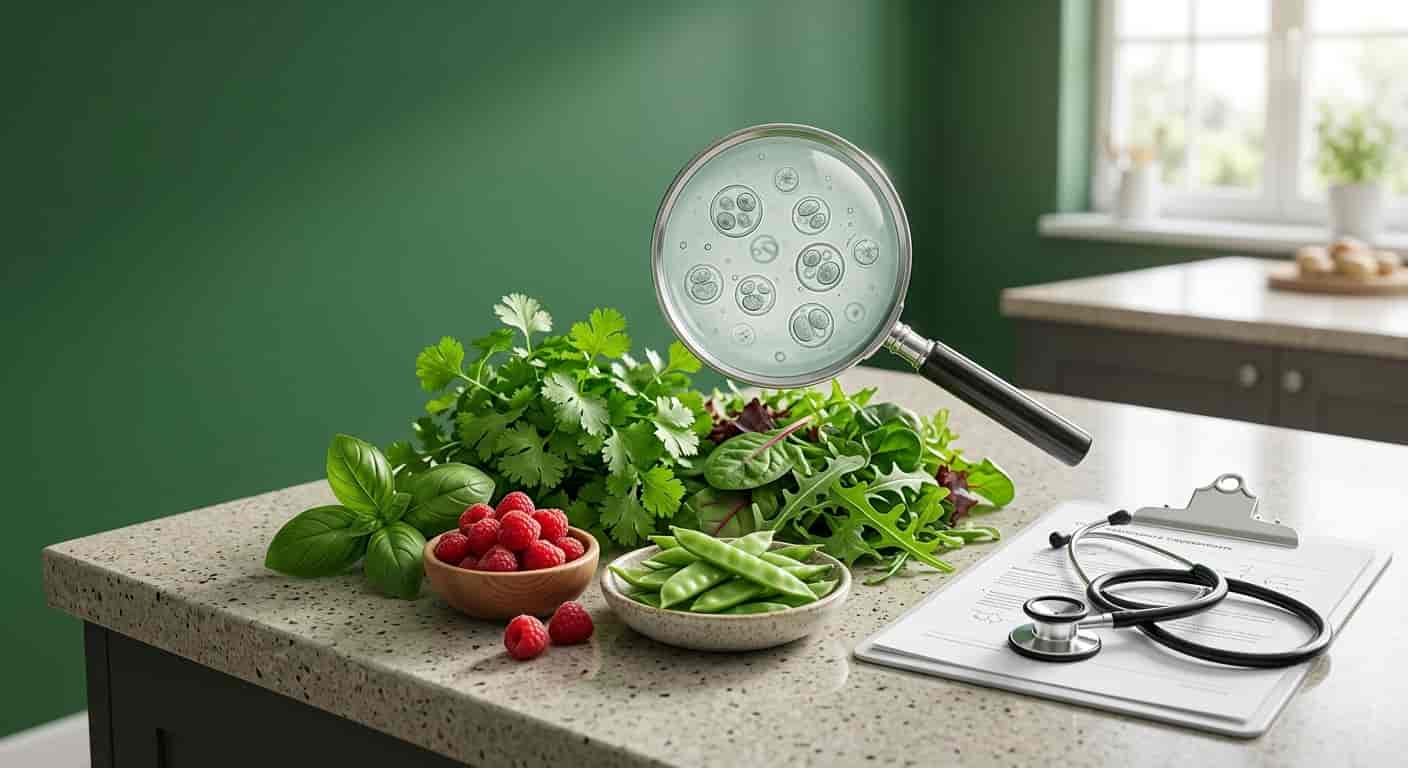
Some of the most common sources include:
- Fresh cilantro
- Imported raspberries
- Fresh basil
- Snow peas
- Pre-packaged salad mixes
- Mesclun greens
These foods share one thing in common.
They’re usually eaten raw.
Cooking would destroy the parasite, but salads, herb garnishes, berry parfaits, and vegetable platters skip that protective step.
One classic example appears again and again during outbreak investigations.
A catering company prepares hundreds of fresh salads for a conference, corporate lunch, or wedding reception.
Everything looks beautiful.
Guests compliment the food.
About a week later, people living in different cities—and sometimes different states—begin experiencing identical digestive symptoms.
Only later do investigators discover that everyone ate cilantro or berries originating from the same contaminated shipment.
That’s why modern food traceback investigations can become incredibly complex.
A single farm can unknowingly supply dozens or even hundreds of distributors before anyone realizes a problem exists.
Something most people don’t know about washing produce
Here’s one fact that surprised even me when I first learned it.
Many people believe soaking vegetables in vinegar or using commercial produce washes removes every dangerous microorganism.
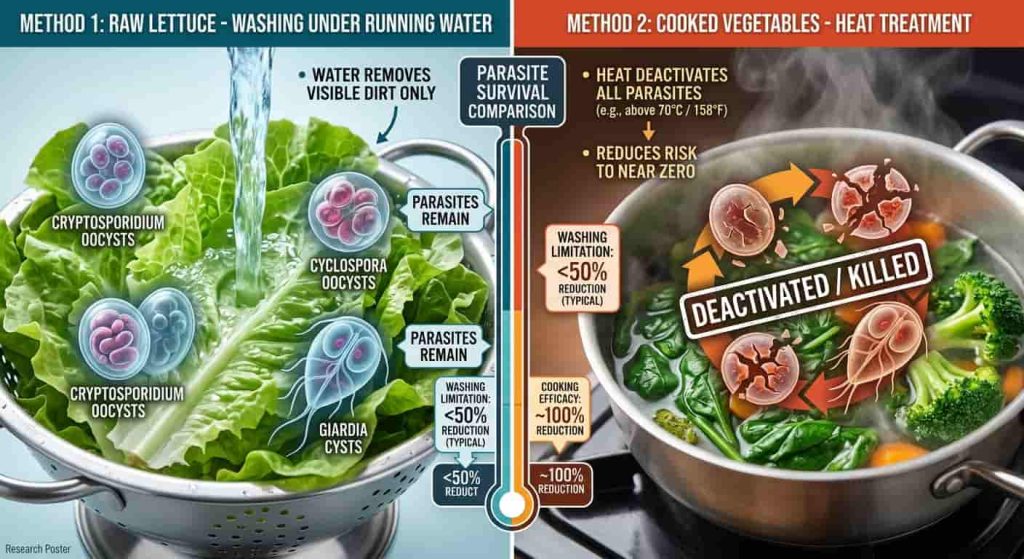
Unfortunately, Cyclospora cayetanensis doesn’t cooperate.
Its microscopic oocysts are remarkably resilient.
Research has shown that:
- Plain tap water isn’t enough.
- Vinegar soaks aren’t reliable.
- Commercial fruit and vegetable washes aren’t guaranteed to remove it.
- Standard chlorine concentrations don’t effectively destroy it.
That’s one reason outbreaks continue despite consumers trying to wash fresh produce carefully.
When practical, peeling fruits provides extra protection.
Cooking offers the greatest level of safety because heat destroys the parasite.
For delicate herbs and leafy greens that are traditionally eaten raw, prevention relies much more on safe farming practices and careful food production than on anything you can do at home.
Cyclospora Symptoms: What Does This Infection Actually Feel Like?
One of the biggest reasons cyclosporiasis is overlooked is that it rarely announces itself in an obvious way.
It creeps in.
At first, you might blame last night’s dinner.
Maybe you assume it’s stress.
Perhaps you think you’ve picked up a routine stomach virus.
Then the symptoms refuse to leave.
I often tell friends that if a stomach illness hangs around much longer than expected, it’s worth asking more questions instead of simply waiting it out.
With Cyclospora cayetanensis, the symptoms usually begin about a week after eating contaminated food. Some people notice problems within two days. Others don’t become sick for nearly two weeks.
That delay makes connecting the illness to a specific meal surprisingly difficult.
The most common cyclospora symptoms include:
- Frequent watery diarrhea
- Sudden, urgent trips to the bathroom
- Abdominal cramping
- Excessive gas and bloating
- Loss of appetite
- Nausea
- Fatigue that seems out of proportion
- Low-grade fever in some cases
- Weight loss during prolonged illness
- General weakness
Watery diarrhea is usually the symptom people remember most.
Not because it’s simply uncomfortable.
Because it keeps coming.
Some people experience six, eight, or even more bowel movements every day.
Sleep becomes difficult.
Travel suddenly feels impossible.
Even going to work turns into a challenge.
Why does fatigue become so overwhelming?
People often expect diarrhea.
They don’t expect the exhaustion.
The fatigue associated with cyclospora disease can feel surprisingly intense.
Several factors contribute.
Your body loses fluids.
Electrolytes become unbalanced.
The inflamed small intestine absorbs nutrients less efficiently.
You’re probably eating less because nothing sounds appealing.
Put all those together, and it’s easy to understand why even climbing stairs may feel exhausting.
The symptom that tricks almost everyone
If I had to point to one feature that separates Cyclospora cayetanensis from many other foodborne infections, this would be it.
Symptoms don’t always stay constant.
They fluctuate.
You might wake up feeling almost normal.
The next day you’re miserable again.
That temporary improvement often convinces people they don’t need medical care.
Unfortunately, the parasite hasn’t necessarily disappeared.
Without proper treatment, the illness frequently follows this relapsing pattern for weeks.
Sometimes longer.
Who Faces the Highest Risk?
Technically, anyone can become infected.
Age doesn’t provide immunity.
Being healthy doesn’t either.
Still, some groups are more likely to develop severe illness or prolonged recovery.
These include:
- Older adults
- Young children
- Pregnant women
- People receiving chemotherapy
- Organ transplant recipients
- Individuals living with weakened immune systems
- People taking medications that suppress immunity
Healthy adults usually recover eventually, but “eventually” isn’t always comforting when you’ve spent three weeks searching for the nearest restroom.
Summer matters more than many people realize
Public health experts notice the same seasonal pattern nearly every year.
Cases rise sharply during warmer months.
Why?
Fresh produce consumption increases.
Imported herbs and berries become widely available.
Large gatherings, catered events, outdoor weddings, and summer festivals all increase opportunities for contaminated produce to reach hundreds of people at once.
That’s one reason health departments pay especially close attention during summer outbreak investigations.

Getting the Right Diagnosis Isn’t Always Easy
Here’s something many people don’t discover until after multiple doctor visits.
A routine stool culture usually doesn’t detect Cyclospora.
That surprises people.
It surprised me when I first learned it.
You might visit an urgent care clinic.
Provide a stool sample.
Receive a report saying everything looks normal.
Yet you’re still experiencing severe diarrhea.
That happens because standard bacterial stool cultures aren’t designed to identify this parasite.
Instead, healthcare providers usually need to order specific testing.
The tests that actually find Cyclospora
Doctors may request:
- A gastrointestinal PCR panel
- Specialized stool parasite examination
- Modified acid-fast staining
- Ultraviolet fluorescence microscopy
Those tests specifically look for Cyclospora cayetanensis rather than assuming bacteria are responsible.
This small detail matters enormously.
Without the correct test, diagnosis may be delayed for weeks.
A practical tip worth remembering
If you’ve had persistent watery diarrhea for over a week—especially after eating fresh produce or during a known summer outbreak—don’t hesitate to ask whether testing for cyclosporiasis should be considered.
You’re not telling your doctor how to practice medicine.
You’re simply making sure an uncommon parasite isn’t accidentally overlooked.
Cyclosporiasis Treatment: What Actually Works?
This is where Cyclospora cayetanensis differs from many routine stomach illnesses.
Time alone doesn’t always solve the problem.
Hydration helps.
Rest helps.
Electrolyte replacement helps.
But none of those eliminate the parasite itself.
The recommended cyclosporiasis treatment is a seven-day course of trimethoprim-sulfamethoxazole (TMP-SMX).
You may recognize its brand names:
- Bactrim
- Septra
These antibiotics specifically target the parasite and are considered the first-line treatment for most patients.
Many people begin feeling noticeably better within several days after starting therapy.
That’s encouraging.
But finishing the entire prescription remains important even if symptoms improve early.
Stopping treatment halfway can allow the infection to persist.
What if you’re allergic to sulfa drugs?
This situation deserves special attention.
Some patients cannot safely take TMP-SMX because of a sulfa allergy.
In those cases, healthcare professionals may consider alternatives such as:
- Ciprofloxacin
- Nitazoxanide
These options may provide benefit for certain individuals.
However, available evidence suggests they generally aren’t as consistently effective as TMP-SMX.
That’s why treatment decisions should always be individualized by a qualified healthcare provider.
What you should do at home while recovering
Medication addresses the parasite.
Recovery still takes care.
Simple measures can make a noticeable difference:
- Drink water frequently.
- Replace electrolytes if diarrhea is significant.
- Eat small meals instead of large ones.
- Choose bland foods while symptoms are active.
- Avoid alcohol until fully recovered.
- Skip greasy, spicy foods for several days.
- Rest more than you think you need.
Your digestive system has been through a lot.
Give it time.
Why Ordinary Antibiotics Don’t Solve Every Stomach Problem
Many people understandably assume that antibiotics are antibiotics.
They’re not.
Different infections require different medications.
Viruses don’t respond to antibiotics.
Many parasites require completely different drugs than bacteria.
Taking unnecessary antibiotics “just in case” may expose you to side effects without treating the real cause.
It can also contribute to antibiotic resistance and disrupt the beneficial bacteria living in your gut.
That’s another reason getting an accurate diagnosis before treatment is so important.
Can You Prevent Cyclospora? Yes—But It Takes More Than Washing Your Salad
If you’ve made it this far, you might be wondering something very practical.
“Should I stop eating fresh fruits and vegetables?”
Absolutely not.
Fresh produce remains one of the healthiest parts of most diets. The goal isn’t to avoid salads forever. It’s to understand where the real risks are and what you can realistically do to reduce them.
When I first learned about Cyclospora cayetanensis, I assumed I could solve the problem with an extra-long rinse under the faucet.
I was wrong.
Unfortunately, this parasite doesn’t behave like loose dirt that simply washes away.
Why rinsing isn’t enough
One of the biggest misconceptions surrounding cyclospora disease is that a thorough rinse completely removes the parasite.
Research says otherwise.
The microscopic oocysts are incredibly sticky and surprisingly resistant.
That means:
- Running water reduces dirt but doesn’t reliably eliminate Cyclospora.
- Vinegar soaks aren’t proven to kill the parasite.
- Commercial vegetable washes aren’t guaranteed to remove it.
- Standard chlorine used in food preparation isn’t enough.
This doesn’t mean washing produce is pointless.
Keep washing fruits and vegetables because it helps remove soil, bacteria, pesticides, and many other contaminants.
Just don’t assume it’s a perfect defense against Cyclospora cayetanensis.
Cooking changes the equation
Heat destroys the parasite.
Whenever possible, cooking vegetables provides a much higher level of protection than eating them raw.
Obviously, nobody wants cooked raspberries on breakfast cereal or boiled lettuce in a salad.
For foods traditionally eaten raw, prevention depends largely on safe agricultural practices, clean irrigation water, hygienic harvesting, and careful handling throughout the food supply chain.
Buying local can help—but it isn’t a guarantee
You’ll often hear advice encouraging people to buy locally grown produce.
I like supporting local farmers whenever I can.
There are genuine benefits.
Shorter supply chains.
Better traceability.
Often fresher produce.
Still, it’s important to stay realistic.
Local food isn’t automatically free of contamination.
Imported food isn’t automatically unsafe.
Good farming practices matter far more than geography alone.
The safest approach combines smart purchasing with proper food handling at home.
Myth vs. Reality
Let’s clear up some of the biggest misunderstandings surrounding cyclosporiasis.
| Myth | Reality |
|---|---|
| You can easily catch Cyclospora from a sick family member. | False. The parasite shed in stool isn’t immediately infectious. It must mature in the environment for one to two weeks before it can infect another person. |
| Cyclospora only affects international travelers. | False. Every summer, domestic outbreaks linked to contaminated produce occur across the United States and Canada. |
| If symptoms disappear for a couple of days, you’re cured. | Not necessarily. Cyclospora cayetanensis is well known for its relapsing pattern. Symptoms often return without proper treatment. |
| Every stool test detects Cyclospora. | False. Routine stool cultures usually miss it. Specialized testing or gastrointestinal PCR panels are often required. |
| Washing produce with vinegar completely removes the parasite. | False. Washing is helpful for general food hygiene but isn’t considered a reliable way to eliminate Cyclospora. |
Foods Most Commonly Linked to Outbreaks
Public health investigations repeatedly identify certain foods during outbreak seasons.
That doesn’t mean these foods are dangerous every time you buy them.
Millions of people eat them safely every year.
They’re simply the foods that have appeared most often during documented investigations.
The usual suspects include:
- Fresh cilantro
- Fresh basil
- Imported raspberries
- Snow peas
- Mesclun greens
- Mixed salad kits
- Other delicate leafy greens eaten raw
These foods are challenging because they have many small surfaces where microscopic contaminants can remain.
What Should You Do If You Think You Have Cyclospora?
Don’t panic.
Most people recover completely with appropriate care.
Here’s a sensible approach.
If you’ve experienced persistent watery diarrhea lasting more than a few days—especially if symptoms disappear and then return—contact your healthcare provider.
Seek medical attention sooner if you notice:
- Signs of dehydration
- Severe weakness
- High fever
- Bloody stools
- Persistent vomiting
- Significant weight loss
- Symptoms lasting longer than one week
Be prepared to answer questions about:
- Recent travel
- Foods you’ve eaten
- Restaurant visits
- Grocery purchases
- Attendance at weddings, conferences, or catered events
These details may seem random.
They’re actually extremely valuable during outbreak investigations.
Long-Term Recovery
The good news?
Most healthy people recover completely after appropriate cyclosporiasis treatment.
That said, recovery isn’t always immediate.
Your intestines need time to heal.
For several weeks afterward, you may notice:
- Temporary sensitivity to rich foods
- Mild digestive discomfort
- Reduced appetite
- Lower energy levels
This gradual improvement is fairly common.
Focus on rebuilding rather than rushing.
Drink enough fluids.
Choose balanced meals.
Add fiber back slowly if your digestive system remains sensitive.
Most importantly, listen to your body.
Frequently Asked Questions
Is Cyclospora contagious?
Not in the same way as viruses like norovirus.
Direct person-to-person transmission is extremely uncommon because the parasite requires time outside the body before becoming infectious.
How long does Cyclospora last?
Without treatment, symptoms may continue for several weeks or even longer.
Proper cyclosporiasis treatment usually shortens the illness considerably.
Can children get Cyclospora?
Yes.
Children can become infected after eating contaminated food or drinking contaminated water.
Because dehydration develops more quickly in children, medical evaluation is especially important.
Does freezing kill Cyclospora?
Current evidence doesn’t support relying on household freezing to eliminate the parasite.
Cooking remains the more dependable safeguard.
Can I become infected twice?
Yes.
Previous infection doesn’t provide lifelong immunity.
Future exposure to contaminated food can lead to another infection.
Should I stop eating salads?
No.
Fresh vegetables provide important nutrients and health benefits.
Continue enjoying them while practicing good food safety and staying informed about outbreak notices.
Key Takeaways
If there’s one lesson I’d like readers to remember, it’s this:
Cyclospora cayetanensis isn’t the most famous foodborne pathogen, but it’s one of the easiest to misunderstand.
It often appears after a delay.
It commonly causes weeks of watery diarrhea instead of a brief stomach upset.
Symptoms frequently improve before returning.
Routine stool cultures may miss it.
And unlike many other causes of food poisoning, the recommended cyclosporiasis treatment is a specific seven-day course of trimethoprim-sulfamethoxazole prescribed by a healthcare professional.
Knowledge really does make a difference here.
Recognizing the pattern early may save weeks of discomfort, unnecessary medications, and repeated doctor visits.
Fresh fruits and vegetables should remain part of a healthy lifestyle. Rather than fearing them, focus on smart food choices, good kitchen hygiene, and paying attention to public health advisories during seasonal outbreaks.
The next time someone tells you, “It’s probably just a stomach bug,” you’ll know there are situations where it’s worth asking one more question.
Sometimes that extra question leads to the right diagnosis—and a much faster recovery.
Read More Article: 7 Best Anti Inflammatory Diet Tips: Easy 2026 Guide
Disclaimer: This article is for educational purposes only and isn’t a substitute for professional medical advice, diagnosis, or treatment.
Please wait to go to the next post: 30 seconds
Go to Next Post