You’re sitting on the couch, watching TV, holding a jar of salted roasted almonds. You tell yourself, “Hey, it’s low-carb! I’m totally fine.”
Then, twenty minutes pass. You look down. The jar is half empty.
Two weeks later, you step on the scale. Nothing moved. In fact, you might even be up a pound.
What gives?
Navigating nuts and low carb diet choices can feel like walking through a dietary minefield. We’re taught to view tree nuts as the ultimate keto staple—packed with good fats, zero sugar, and endless crunch.But the harsh reality is not all nuts are created equal and eating them indiscriminately will break your ketosis in a click more than the slice of a cake.
This guide teaches you exactly how to count net carbs, which nuts ramp up fat burning, which ones hiddenly destroy your results — and what to do about mindless snacking for good. Let’s dig in.
Understanding Carbohydrates in Nuts: How Net Carb Math Works
Calculating Net Carb in Nuts (Total Carbs vs. Dietary Fiber)
If you’re tracking your macros, counting total carbs alone will drive you crazy. You need to master net carbs in nuts to keep your daily intake under control without losing your mind.
The formula is incredibly simple:
Total carbs represent everything in the food. Fiber, however, is a complex carbohydrate that your body simply cannot break down into glucose. It passes through your digestive system largely intact.
When you eat fiber, it doesn’t trigger an insulin spike, nor does it knock you out of ketosis. That’s why we subtract it from the total.
Total Carbs (5g) - Dietary Fiber (3g) = Net Carbs (2g)
Quick Tip: Always double-check store-bought nutrition labels! European and Australian labels frequently list net carbs as “Carbohydrates,” whereas US labels need you to manually deduct the “Dietary Fiber” line from “Total Carbohydrates.”
Fats, Fiber, and Satiety: Why Nuts Belong on Low-Carb Plates
Once carbs are involved, then what’s the point in even eating them? Reason: because monounsaturated fats and soluble fiber are a serious metabolic duo.
In addition healthy fats slow down gastric emptying. This literally fills your stomach up for hours. Fiber gives you bulk while also feeding the gut microbiome which helps with gut health and sustained energy!
Outside of the macros, nuts are also micronutrient powerhouses. They come loaded with:
-
Magnesium: Essential for muscle recovery, deep sleep, and preventing leg cramps during keto adaptation.
-
Zinc: A key player in immune function and hormone regulation.
-
B-Vitamins: Crucial for cellular energy production and metabolic pathways.
When eaten in strategic amounts, nuts aren’t just allowed; they’re an absolute game-changer for long-term diet adherence.

The Green Tier: The Absolute Lowest Carb Nuts for Keto and Low-Carb
Once carbs are involved, then what’s the point in even eating them? Reason: because monounsaturated fats and soluble fiber are a serious metabolic duo.
In addition healthy fats slow down gastric emptying. This literally fills your stomach up for hours. Fiber gives you bulk while also feeding the gut microbiome which helps with gut health and sustained energy!
Outside of the macros, nuts are also micronutrient powerhouses. They come loaded with:
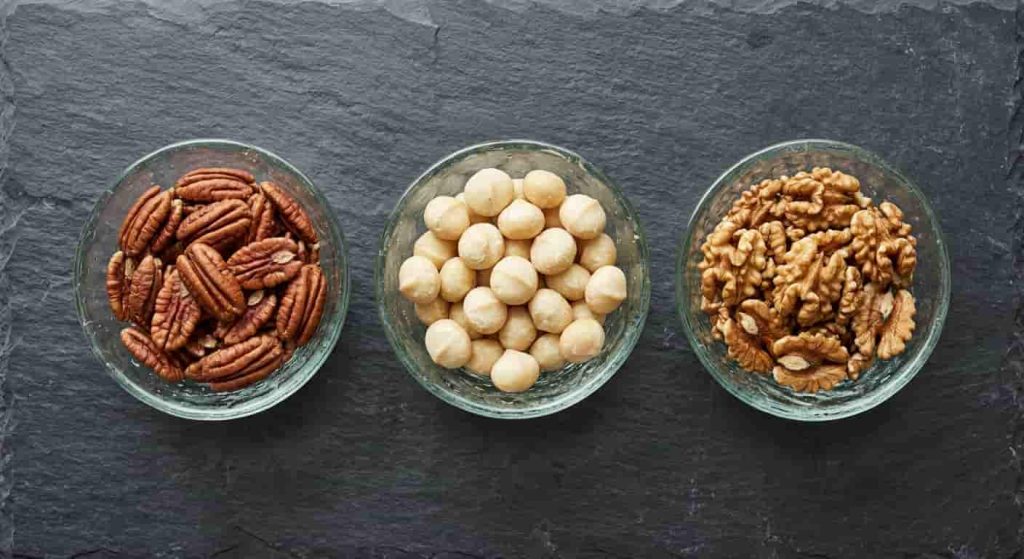
Pecans: The Net Carb Champion
Pecans take the golden crown in the low-carb community. They pack a buttery texture with an astonishingly small carb footprint.
-
Nutrition per 1 oz (28g / ~19 halves):
-
Net Carbs: 1.2g (Total Carbs: 3.9g, Fiber: 2.7g)
-
Fat: 20g
-
Protein: 2.6g
-
Pecans are rich in soluble fiber, which actively supports heart health by helping reduce LDL cholesterol levels. Toss them into salads, crush them as a “breading” for chicken, or eat them raw.
Macadamia Nuts: Monounsaturated Fat Powerhouses
When it comes to keto-friendly fat ratios, macadamias stand in a league of their own. Understanding macadamia net carbs is key if you struggle to hit your daily fat goals without piling on extra carbohydrates.
-
Nutrition per 1 oz (28g / ~10-12 nuts):
-
Net Carbs: 1.5g (Total Carbs: 3.9g, Fiber: 2.4g)
-
Fat: 21.5g
-
Protein: 2.2g
-
Over 75% of the fat in macadamias is monounsaturated, the exact same heart-healthy fat found in extra virgin olive oil. They are creamy, rich, and almost impossible to overeat if you pay attention to their density.
Brazil Nuts: Metabolism Boosters with a Critical Caveat
Brazil nuts are massive, crunchy, and exceptionally low in digestible sugar.
-
Nutrition per 1 oz (28g / ~6 nuts):
-
Net Carbs: 1.3g (Total Carbs: 3.3g, Fiber: 2.0g)
-
Fat: 19g
-
Protein: 4g
-
The Critical Caveat: You must respect the Brazil nut. Just one single nut supplies over 100% of your daily recommended intake of Selenium, a mineral vital for thyroid health.
However, eating too many daily can lead to Selenium toxicity (selenosis), causing hair loss, nausea, and nerve damage. Stick to a hard limit of 2 to 4 nuts per day.
Walnuts: The Omega-3 Superstar
Walnuts are unique among tree nuts due to their high concentration of plant-based essential fatty acids.
-
Nutrition per 1 oz (28g / ~14 halves):
-
Net Carbs: 2.0g (Total Carbs: 3.9g, Fiber: 1.9g)
-
Fat: 18.5g
-
Protein: 4.3g
-
They are rich in Alpha-Linolenic Acid (ALA), an omega-3 fatty acid linked to lower systemic inflammation, improved vascular function, and enhanced cognitive health.
The Yellow Tier: Moderate-Carb Nuts to Enjoy in Controlled Portions
These options are incredible for health and taste, making them some of the best keto nuts around. But exercise caution: their carb count creeps up faster than the green tier options.
Almonds: The Low-Carb Workhorse
Almonds are the undeniable backbone of low-carb living. From whole snacks to almond flour pancakes, they are everywhere.
-
Nutrition per 1 oz (28g / ~23 almonds):
-
Net Carbs: 2.6g (Total Carbs: 6.1g, Fiber: 3.5g)
-
Fat: 14g
-
Protein: 6g
-
They are packed with Vitamin E and calcium. However, because they are so accessible and easy to chew, mindless overeating is a constant risk.
Hazelnuts: Great for Fiber and Heart Health
Hazelnuts offer a rich, sweet flavor profile without blowing your daily macro budget.
-
Nutrition per 1 oz (28g / ~21 nuts):
-
Net Carbs: 2.0g (Total Carbs: 4.7g, Fiber: 2.7g)
-
Fat: 17g
-
Protein: 4.2g
-
They boast high levels of folate and Vitamin E, making them brilliant for skin health and metabolic protection.
Peanuts: Legume Facts, Net Carbs, and Inflammatory Profiles
Here’s a fun party fact: peanuts aren’t tree nuts! They are botanically legumes, growing underground inside pods like beans and lentils.
-
Nutrition per 1 oz (28g / ~28 peanuts):
-
Net Carbs: 3.8g to 4.6g (Total Carbs: 6.0g, Fiber: 2.2g)
-
Fat: 14g
-
Protein: 7.3g
-
While high in protein, peanuts present two issues:
-
Aflatoxins: Fungal toxins that can grow on peanuts during storage, potentially irritating sensitive digestive systems.
-
Omega-6 Fatty Acids: They contain high levels of linoleic acid, which can promote inflammation if consumed in excess without balancing omega-3s.
The Red Tier: High-Carb Nuts to Avoid or Limit Strictly
Now we are in dangerous territory Although these nuts have excellent nutritional profiles, their digestible sugar and starch content is too high for strict low-carbohydrate and ketogenic diets.
Cashews: Why They Threaten Ketosis
Cashews are a crowd-pleaser for good reason; they pack a mild, creamy flavor and an addictively buttery texture. But that sweetness will cost you. So if your goal is to keep burning fat, then knowing how many carbs are in cashews in this important!
-
Nutrition per 1 oz (28g / ~18 nuts):
-
Net Carbs: 8.9g (Total Carbs: 9.3g, Fiber: 0.4g)
-
Fat: 12.4g
-
Protein: 5.1g
-
Here is the problem: two small handfuls of cashews can easily push you past 20 grams of net carbs—destroying your entire daily carb budget in under three minutes.
1 oz Cashews = 8.9g Net Carbs (Nearly 45% of a strict 20g keto daily limit!)
Pistachios: The High-Carb Snack Trap
Pistachios present a double threat: high net carbohydrates and an addictive cracking mechanism that tricks your brain.
-
Nutrition per 1 oz (28g / ~49 kernels):
-
Net Carbs: 5.8g to 7.7g (Total Carbs: 8.0g, Fiber: 2.9g)
-
Fat: 13g
-
Protein: 5.7g
-
While buying them in the shell slows down your eating speed, their overall starch content remains too high for daily snacking on a low-carb diet.
Chestnuts: High-Starch Exclusions
Chestnuts are unique in the nut world, but not in a good way for keto dieters.
-
Nutrition per 1 oz roasted (28g):
-
Net Carbs: ~13.6g (Total Carbs: 15g, Fiber: 1.4g)
-
Fat: 0.6g
-
Protein: 0.9g
-
Chestnuts behave metabolically like grains or potatoes rather than oilseeds. They are virtually pure starch and extremely low in fat. Avoid them completely on low-carb regimes.
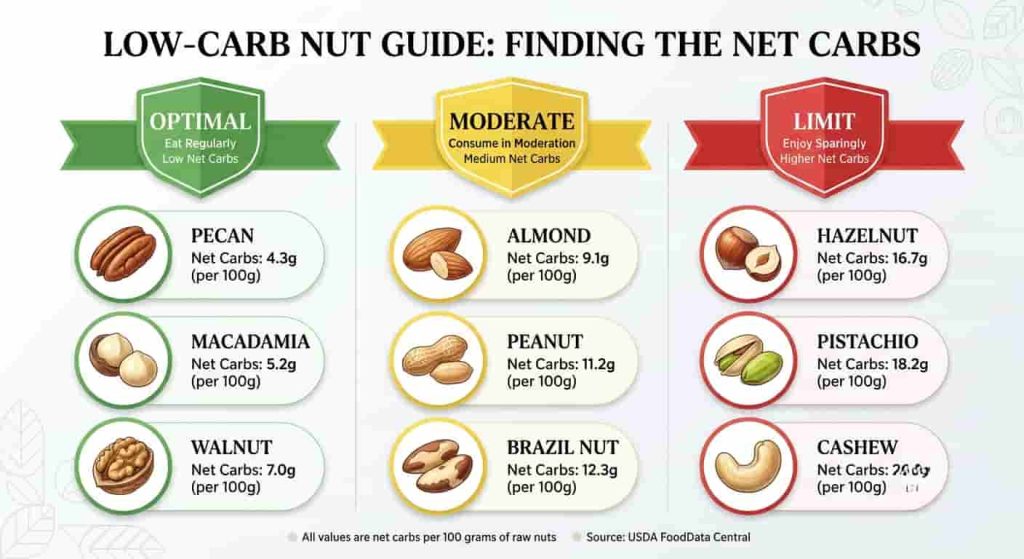
Master Macronutrient & Net Carb Comparison Chart
Complete Nut Reference Matrix (Per 1 oz / 28g Serving)
Use this handy reference table to quickly make smart choices at the grocery store.
| Nut Variety | Total Carbs (g) | Dietary Fiber (g) | Net Carbs (g) | Total Fat (g) | Protein (g) | Low-Carb Tier |
| Pecans | 3.9 | 2.7 | 1.2 | 20.0 | 2.6 | Green (Optimal) |
| Brazil Nuts | 3.3 | 2.0 | 1.3 | 19.0 | 4.0 | Green (Optimal) |
| Macadamia | 3.9 | 2.4 | 1.5 | 21.5 | 2.2 | Green (Optimal) |
| Walnuts | 3.9 | 1.9 | 2.0 | 18.5 | 4.3 | Green (Optimal) |
| Hazelnuts | 4.7 | 2.7 | 2.0 | 17.0 | 4.2 | Yellow (Moderate) |
| Almonds | 6.1 | 3.5 | 2.6 | 14.0 | 6.0 | Yellow (Moderate) |
| Peanuts | 6.0 | 2.2 | 3.8 | 14.0 | 7.3 | Yellow (Moderate) |
| Pistachios | 8.0 | 2.9 | 5.8 | 13.0 | 5.7 | Red (Limit) |
| Cashews | 9.3 | 0.4 | 8.9 | 12.4 | 5.1 | Red (Limit) |
Why Nuts Can Stall Weight Loss on a Low-Carb Diet
Have you hit a weight loss wall despite keeping your carbs super low? Nuts are frequently the hidden culprit behind keto weight loss stalling.
Caloric Density vs. Volume Satiety
One gram of fat contains 9 calories, while protein and carbohydrates provide only 4 calories per gram. Nuts contain a high caloric density due to their healthy oils.
Just a 3-ounce handful of macadamias has almost 600 calories. Though visually and physically, that handful uses hardly any space.
1 Cup Almonds ≈ 800 Calories
VS.
1 Cup Roasted Broccoli + 8 oz Chicken Breast ≈ 380 Calories
If your stomach doesn’t stretch, your brain doesn’t receive the physical volume signals needed to shut off hunger hormones quickly.
The Hyper-Palatability Factor: Salt, Oils, and Grazing
Raw nuts are somewhat plain. But dry-roasted, heavily salted or oil-roasted nuts? They touch the exact trifecta of hyper-palatability in fats, salts, and crunch.
This combo turns off your natural satiety signals, so that your brain will not receive the signal to stop eating. You find yourself winding up grazing straight off the bag as you work or watch movies, gulping down hundreds of calories without even realizing it
Actionable Protocol: Overcoming a Nut-Induced Weight Loss Plateau
If your weight loss has halted for more than two weeks, execute this simple 7-day nut audit to reboot your progress:
-
Step 1: Eliminate Nut Grazing. Stop eating directly from large bags or jars immediately.
-
Step 2: Take a 7-Day Break. Remove all whole nuts, nut butter, and nut flours from your diet for one full week.
-
Step 3: Track Caloric Intake. Notice if your appetite stabilizes and weight starts dropping again.
-
Step 4: Reintroduce with Scale Control. Bring back only Green Tier nuts, weighing out 28-gram portions on a digital scale before eating.
Raw vs. Roasted vs. Flavored: Processing Traps to Watch For
The way your food is prepared matters just as much as macro ratios when comparing raw vs roasted nuts low carb options.
Raw vs. Dry Roasted vs. Oil Roasted
Raw nuts keep intense heat-sensitive vitamins and sensitive fatty acids intact.
In contrast, the dry-roasted and oil-roasted nuts that are commonly found in stores are frequently processed at high temperatures. This oxidation, in turn, can cause the breakdown of sensitive polyunsaturated fats that forms free radicals.
Even worse commercial brands usually roast them in cheap, super-inflammatory vegetable oils:
-
Canola Oil
-
Sunflower Oil
-
Soybean Oil
-
Cottonseed Oil
Always check labels carefully and opt for raw or dry-roasted nuts prepared without added industrial seed oils.
Hidden Sugars and Glazes
“Honey roasted,” “sweet chili,” or “maple spiced” nuts are obvious landmines. But even savory flavors carry hidden traps.
Manufacturers routinely dust flavored snacks with maltodextrin, cornstarch, and wheat flour to help seasonings stick. Maltodextrin actually has a higher glycemic index than pure table sugar!
Anti-Nutrients & Digestion: Phytates, Lectins, and Sprouting
Raw nuts naturally contain phytic acid and lectins—compounds that protect the seed in nature but can irritate human digestive systems.
Phytic acid binds to vital minerals like iron, zinc, and calcium, reducing their absorption in your gut.
Solution: Purchase sprouted nuts, or soak raw nuts in salted water for 12 hours at home and dehydrate them under their supervision at low temperature. This process also degrades phytates so that minerals are available with bioavailability, and nuts become much easier to digest.

Low-Carb Nut Butters, Flours, and Milks: Buyer’s Guide
Selecting a Clean Low-Carb Nut Butter
When buying a low carb nut butter, ingredient lists must be short and clear.
-
The Ideal Ingredient List: “Almonds, Salt.” (That’s it!)
-
Ingredients to Avoid: Hydrogenated palm oil, added cane sugar, high fructose corn syrup, and mono- and diglycerides.
Macadamia and walnut butter offer superior fat-to-carb ratios, whereas peanut butter requires strict portion control due to higher sugar levels.
Baking with Nut Flours: Almond vs. Pecan vs. Macadamia Flour
Substituting traditional wheat flour with nut flour makes low-carb baking possible:
-
Almond Flour (Superfine): The absolute standard for keto baking. Replaces white flour at a 1:1 volume ratio in most recipes, though it requires slightly more egg binder.
-
Pecan Flour: Exceptionally low net carbs with a rich, pie-crust flavor. Perfect for savory breading and tart crusts.
-
Macadamia Flour: High fat and extremely tender. Best used for decadent keto cookies and rich crumbles.
Plant Milks: Avoiding Carbs in Commercial Nut Milks
Unsweetened almond and macadamia milks are also great choice, containing less than 1g of net carbs per serving.
However, double-check label claims! Up to 15g of added sugar per serving is often hidden in “original” varieties Buy the ones that are made from ingredients that are labeled as “Unsweetened“. Do not use brands with thickeners such as oat flour or rice starch.
Smart Portion Control Strategies for Low-Carb Diets
Mastering portion control keto snacks allows you to enjoy crunch without ruining fat loss goals.
Pre-Portioning Techniques to Avoid Mindless Snacking
-
Ditch the Bag: Never eat directly out of bulk packaging.
-
Use the Digital Scale: Measure exact 28g (1 oz) portions using a kitchen scale.
-
Prep Snack Containers: Spend 10 minutes on Sunday dividing bulk nuts into individual glass containers or silicone bags for the week ahead.
Pairing Nuts with Protein for Maximum Satiety
Because nuts pack low protein relative to their fat calories, pairing them with dense protein sources slows digestion down further and maximizes satiety.
Try these smart pairings:
-
1 oz Pecans + 2 Hard-Boiled Eggs
-
1 oz Walnuts + 2 oz Aged Cheddar Cheese
-
1 oz Macadamia Nuts + 1/2 cup Unsweetened Greek Yogurt

Read:15 Easy Finnish Recipes at Home (30-Min Comfort Food)
Frequently Asked Questions
Which nuts have the lowest net carbs for a low-carb diet?
Pecans hold the top spot with just 1.2g of net carbs per 1 oz (28g) serving. Brazil nuts (1.3g) and macadamia nuts (1.5g) follow extremely closely behind, making all three absolute staples for low-carb and keto diets.
Are cashews allowed on a keto or low-carb diet?
For most people, cashews are not a good fit with strict keto. The Equivalent of just 1-oz which only handful, is already close to 9g of net carbs and can almost shaquille your whole he never even realizes you haave been eating more than half his daily carbohydrate allowance.
Why do nuts stall weight loss on a low-carb diet?
Nuts are very calorie dense and easy to overeat. Eating hyper-palatable, low volume salted roasted nuts leads to excess hundreds of calories, without satiety signals leading to impaired weight loss progress.
How many nuts can I eat a day without exceeding my daily carb limit?
A ideal standard target is one single 1-ounce (28g) serving per day. This delivers healthy fats, crunch, and micronutrients while keeping your net carb contribution safely under 2 to 3 grams.
Are peanuts considered low-carb, and are they technical tree nuts?
Peanuts are legumes, not tree nuts. They can work within moderate low-carb (3.8g–4. (Relatively high anti-nutrient profiles and digestive inflammation in sensitive individuals, 6g net carbs per oz)
What is your all-time favorite low-carb nut for snacking, or are you in the hunt of crossing a weight loss plateau?
Legal Disclaimer: This article is not a substitute for professional medical or nutritional advice. Disclaimer: You should always consult your healthcare provider before making changes to your diet or exercise plan.
Please wait to go to the next post: 30 seconds
Go to Next Post