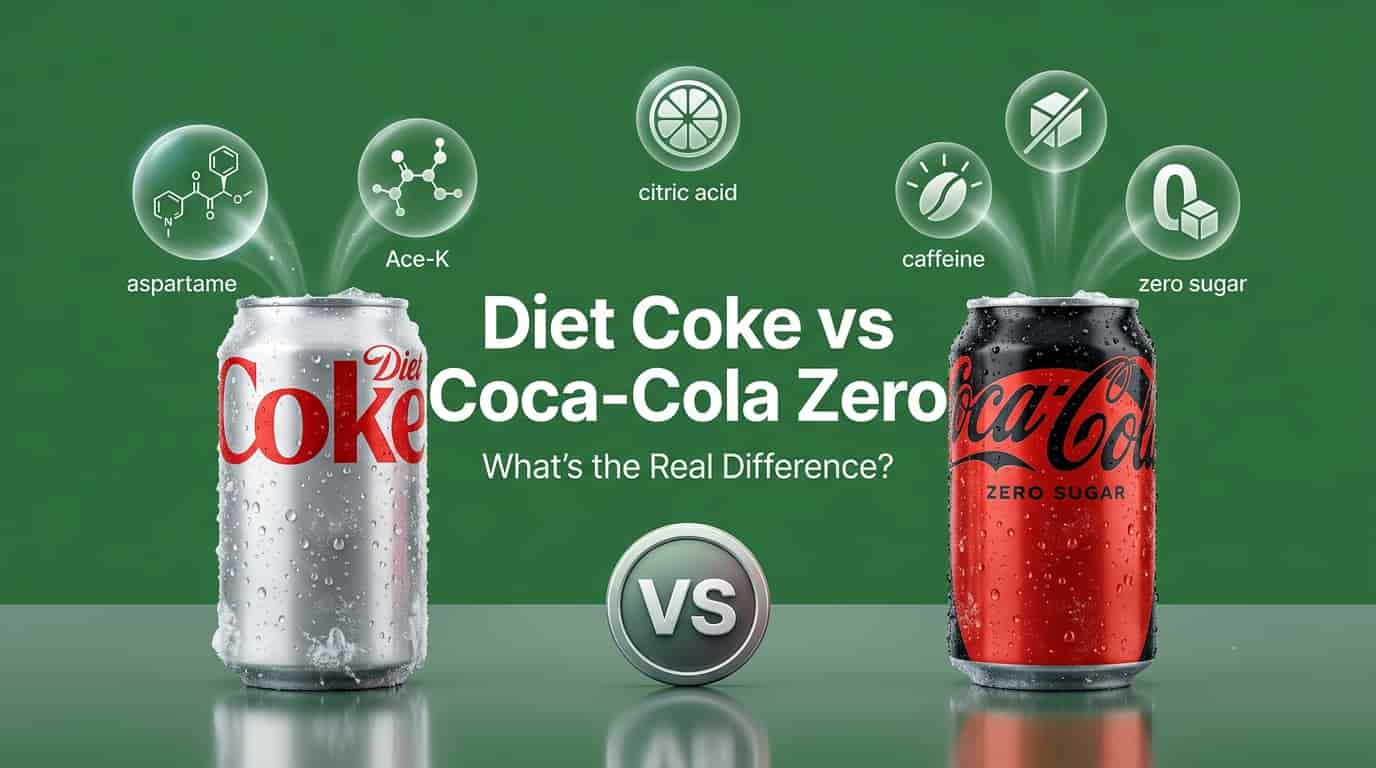
Ever found yourself at the grocery store staring at two almost identical cans in front of you, thinking, “Hold on. How – not only can you produce your own Diet Coke at home, or even better – what is the diffirence between a Saul Goodman Coca-cola and an out-of-date version of it?
You’re definitely not alone.
I’ve been there too. Once upon a time, I just picked up whatever can was nearest me. Both had zero sugar. Both had almost no calories. Both carried the Coca-Cola name. Thought they were pretty much the same drink wearing different clothes.
Turns out, I was wrong.
The weird part is that millions of people ask what the difference is between diet coke and coca cola zero every single year.Should you want to know, no, it’s not because they taste different. The story goes much deeper. It includes food science, flavor chemistry, psychology, marketing, levels of caffeine absorption and our very own brains’ memories of taste!
And therein lies why this topic is such an interesting one.
It can help if you’re looking to cut down on sugar, control diabetes or lose weight — or you just want to know why one is a silver can and the other black and red.
Along the way we will also tackle commonly asked questions like, what is the difference between diet coke and coke zero, which is healthier, and why loyal fans of both these soft drinks often balk at switching from one to the other.
At the end of this, you’ll see why Coca-Cola has each drink for sale even though they could replace one with the other.
To begin with the most crucial difference between all.
They Were Never Designed to Be the Same Drink
And this is the kicker, that most people struggle with.
Diet Coke was never designed to taste like Coca-Cola.
Read that again.
Coca-Cola didn’t even try to get the sugar out of Coca-Cola Classic when it launched Diet Coke in 1982. Rather, they built a totally different drink all of its own character.
That decision changed everything.
Diet Coke has always tasted milder.
It’s crisp.
It’s bright.
It ends on a pronounced tang.
It’s actually a taste that a lot of longtime fans have grown to prefer over the normal Coke.
Coca-Cola Zero Sugar was another story altogether.
It was a different kind of assignment Coca-Cola set for scientists when they launched in 2005.
Rather than inventing a new flavour they asked a question much more difficult —
“Can we recreate the taste of classic Coca-Cola without using sugar?”
That single goal explains nearly every difference between the two drinks.
So when people ask what’s the difference between coca cola zero and diet coke, they’re really comparing two beverages created with two completely different philosophies.
One celebrates being different.
The other tries its hardest not to be.
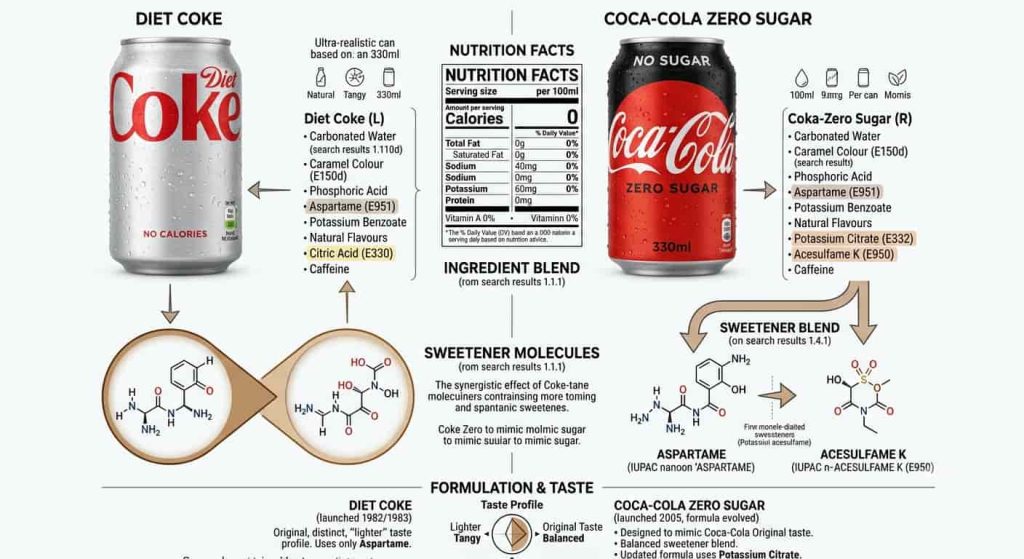
Actually, if you compare the nutrition labels first, Diet Coke and Coca-Cola Zero Sugar look almost identical. Both contain zero calories, zero sugar, and virtually no carbohydrates, making them popular alternatives to regular Coca-Cola for people who want to cut back on added sugar. They also share most of their ingredient list, including carbonated water, caramel color, phosphoric acid, potassium benzoate as a preservative, aspartame, natural flavors, and caffeine. That similarity often leads people to assume they’re the same drink with different packaging, but the ingredient list tells a more interesting story.
The differences begin with just a few carefully chosen ingredients. Coca-Cola Zero Sugar includes acesulfame potassium (Ace-K) and potassium citrate, while Diet Coke contains citric acid instead. Those small changes have a surprisingly big influence on flavor. Ace-K works alongside aspartame to create a sweetness that many people feel comes closer to regular Coca-Cola, while potassium citrate softens the drink’s acidity, giving Coke Zero a smoother, fuller mouthfeel. Diet Coke, on the other hand, uses citric acid to produce its signature crisp, bright finish that loyal fans instantly recognize. According to Coca-Cola, this difference is intentional: Diet Coke was created with its own lighter flavor profile, whereas Coke Zero Sugar was specifically developed to resemble the taste of Coca-Cola Classic as closely as possible.
Both beverages are also available in caffeine-free versions, making them suitable for people who enjoy the flavor of cola but prefer to avoid caffeine later in the day. Depending on your location, these caffeine-free varieties are typically identified by gold-colored accents on the packaging, making them easy to distinguish from the standard versions. So while the two drinks share far more similarities than differences, those subtle formulation changes are exactly why they deliver noticeably different drinking experiences
Why Diet Coke Has a Sharper Taste
Taste isn’t random.
It’s chemistry.
Citric acid is one of the main acidulants in Diet Coke.
Citric acid is a natural component of citrus fruits.
It is a bright, fresh accent that some people would call zing or bit acidic.
This is also why, for instance, Diet Coke frequently tastes more refreshing right after the first sip.
Some even say it has more “kick” to it.
That characteristic wasn’t an accident.
It was designed that way.
Why Coke Zero Feels More Like Real Coca-Cola
Coca-Cola Zero Sugar uses potassium citrate instead of relying on citric acid in the same way.
That small formulation change has a surprisingly large effect.
Potassium citrate softens the overall acidity.
Instead of delivering a sharp finish, it creates a smoother mouthfeel that resembles regular Coca-Cola.
Imagine comparing sparkling lemonade with classic cola.
One wakes up your taste buds instantly.
The other feels richer and rounder.
That’s essentially the difference.
This is also why blind taste tests often show Coke Zero performing better among people who normally drink original Coca-Cola.
Its flavor memory is closer to the real thing.
The Science Behind the Sweetness Is More Interesting Than You Think
Many people assume both drinks use exactly the same artificial sweetener.
Actually, they don’t.
This is one of the biggest reasons the flavor experience changes.
Diet Coke Relies Mostly on Aspartame
Diet Coke gets nearly all of its sweetness from aspartame.
Aspartame has been studied for decades.
It’s roughly 200 times sweeter than sugar.
Only tiny amounts are needed.
The challenge is that aspartame can leave a slight lingering sweetness after swallowing.
Some people notice it immediately.
Others don’t notice it at all.
Taste perception is incredibly personal.
That’s why two friends can drink the same soda and describe completely different experiences.
Coke Zero Uses Teamwork Instead of One Star Player
Coke Zero takes a different approach.
Instead of asking one sweetener to do all the work, it combines aspartame with acesulfame potassium, often called Ace-K.
Think of it like a duet instead of a solo performance.
Here’s why food scientists like this combination.
Ace-K produces sweetness almost instantly.
Aspartame develops more gradually and lasts longer.
Together they balance each other.
Even better, Ace-K helps reduce the lingering aftertaste of aspartame, while aspartame softens the quick sweetness produced by Ace-K.
It’s called sweetener synergy.
The result feels surprisingly close to ordinary table sugar.
That’s why someone wondering what’s the difference between zero coke and diet coke often notices that Coke Zero tastes richer even though both drinks contain virtually no calories.
Does One Have More Caffeine?
Yes.
This catches plenty of people off guard.
A standard 12-ounce can contains approximately:
- Diet Coke: about 46 mg of caffeine
- Coca-Cola Zero Sugar: about 34 mg of caffeine
That means Diet Coke delivers roughly one-third more caffeine.
Will you suddenly feel hyper?
Probably not.
For comparison, a typical cup of brewed coffee contains around 90 to 120 milligrams.
Still, if you’re especially sensitive to caffeine or enjoy several cans throughout the day, the difference can add up.
Some Diet Coke fans even say that slightly higher caffeine contributes to the drink’s signature crispness.
Whether that’s chemistry or psychology is still open for debate.
A Small Mineral Difference Most People Never Notice
Here’s an overlooked detail.
Both drinks contain about the same amount of sodium.
But Coke Zero also contains potassium because of its potassium citrate formulation.
It’s not enough to make it a meaningful nutritional source.
Still, it’s another subtle difference hidden inside the ingredient list.
Tiny details like these explain why food scientists don’t consider the beverages identical, even though their nutrition labels appear remarkably similar.
Are They Equally Healthy? Here’s What the Evidence Says
This is where conversations about these drinks often become emotional.
I’ve heard people confidently say, “Diet Coke is worse.”
Others insist, “Coke Zero is healthier because it tastes more natural.”
Neither statement tells the whole story.
If we’re talking strictly about nutrition, the two drinks are remarkably close.
Both contain virtually no calories.
Both contain no sugar.
Both contain no carbohydrates.
Neither provides meaningful amounts of vitamins, protein, healthy fats, or fiber.
So if someone asks me what’s the difference between diet coke and coke zero, I don’t point to the nutrition label first. I point to the ingredient list and the flavor profile, because that’s where the meaningful differences exist.
Blood Sugar and Diabetes
Sugar-free soda is popularly chosen by people, and one of the reasons for this choice is blood gum control.
The good news?
Neither in Diet Coke nor in Coca-Cola Zero is sugar present, which can penetrate the blood rapidly and too high level.
They mostly don’t cause the same blood sugar response as regular Coca-Cola drinks, since they do not break down in your body into absorbable carbohydrates.
If someone has chosen an option in place of a daily sugar-sweetened soda, both options can cut out approximately 140–150 calories and around 39 g of media rights per can.
That’s a meaningful change.
This makes it much easier to follow a calorie-controlled eating plan.
Still, sugar-free soda should not be used as your main beverage instead of water.
Consider it an occasional replacement, not a nutrition boost.
Can They Help With Weight Loss?
Here’s the honest answer.
They can help.
But they aren’t magic.
Imagine someone drinks two cans of regular Coca-Cola every day.
Replacing those with Diet Coke or Coke Zero removes hundreds of calories each day without requiring them to give up the habit of enjoying a fizzy drink.
That’s one reason healthcare professionals sometimes recommend sugar-free beverages as a stepping stone.
The important word is stepping stone.
Weight loss still depends on the overall pattern of eating, physical activity, sleep, and consistency.
A zero-sugar soda doesn’t automatically make a meal healthy.
A cheeseburger, large fries, and a Diet Coke still add up.
What About Dental Health?
People are often surprised by this answer.
These drinks are better for your teeth than regular sugary soda.
But they aren’t completely harmless.
Here’s why.
Cavity-causing bacteria feed on sugar.
Since Diet Coke and Coke Zero don’t contain fermentable sugars, they don’t fuel those bacteria the same way regular soda does.
That’s a real advantage.
However, both drinks remain acidic.
Acid can slowly soften tooth enamel over time.
If you enjoy them regularly, a few simple habits can help:
- Drink them with meals instead of sipping for hours.
- Avoid brushing immediately afterward because enamel is temporarily softened.
- Rinse your mouth with plain water.
- Keep water as your everyday beverage.
Those small habits make a noticeable difference over time.
The Biggest Myths About Diet Coke and Coke Zero
The internet has never been short on opinions.
Unfortunately, many of them aren’t supported by good evidence.
Let’s separate fact from fiction.
Myth: Artificial Sweeteners Cause a Huge Insulin Spike
This claim appears on social media almost every week.
The reality is much less dramatic.
Scientists have studied what’s known as the cephalic phase insulin response for years.
This refers to the tiny physiological response that can occur simply from tasting something sweet.
Current human research shows that the sweeteners used in Diet Coke and Coke Zero do not create a clinically meaningful insulin surge in healthy people.
They also don’t trigger dangerous drops in blood sugar simply because they taste sweet.
That’s one reason they’re commonly used by people managing diabetes or insulin resistance.
Of course, every person has unique medical needs.
If your healthcare provider recommends avoiding certain products, follow that advice.
Myth: Coke Zero Is Much Healthier Than Diet Coke
That belief probably stems from the marketing.
The black can feels modern.
Well, that sounds less like a diet.
The flavor resembles regular Coca-Cola.
Psychologically, they take that to mean it’s healthier.
Turns out, from a nutrition standpoint, they’re pretty much identical.
However, neither beverage qualifies as a health food.
Neither provides meaningful nutrition.
One ingredient difference does not make either suddenly unhealthy.
The choice between the two are mostly a matter of taste.
Not clinical nutrition.
Myth: Diet Soda Automatically Causes Weight Gain
This topic deserves a balanced answer.
Some observational studies have noticed that people who drink more diet soda also tend to have higher body weights.
That doesn’t necessarily mean the soda caused the weight gain.
Think about it.
People trying to lose weight are also more likely to choose diet beverages.
Researchers call this reverse causation.
When controlled clinical studies compare replacing sugary drinks with diet versions, the results generally show that removing sugar can support calorie reduction.
Again, the overall eating pattern matters most.
Why Coke Zero Exists at All
Here’s one of my favorite stories in the soft drink industry.
It has almost nothing to do with nutrition.
It has everything to do with psychology.
During the early 2000s, Coca-Cola noticed something interesting.
Many young men wanted sugar-free drinks.
But they avoided buying Diet Coke.
Not because they disliked the taste.
Because of the word Diet.
Market research found that many male consumers associated the silver can with dieting, calorie counting, and products aimed primarily at women.
The company realized they weren’t losing customers because of flavor.
They were losing them because of perception.
So they changed the conversation.
Instead of launching “Diet Coke 2,” Coca-Cola introduced Coke Zero.
The packaging turned black.
The advertising featured sports, speed, and action.
The messaging focused on enjoying cola without compromise rather than on dieting.
It worked.
Remarkably well.
An entirely new audience embraced the drink.
That’s why asking what’s the difference between coca cola zero and diet coke isn’t only about ingredients.
It’s also about branding.
Two products.
Two identities.
Two groups of loyal fans.
The 2021 Recipe Change That Sparked a Backlash
If you think people don’t notice tiny flavor changes, think again.
In 2021, Coca-Cola updated Coke Zero Sugar to make it taste even closer to original Coca-Cola.
The company also redesigned the packaging.
The familiar black can shifted toward a mostly red design with black lettering.
On paper, it seemed like a logical improvement.
But something unexpected happened.
Thousands of loyal Coke Zero drinkers complained online.
Some said it tasted sweeter.
Others claimed it felt heavier.
Many insisted the original version had been better.
This phenomenon has a fascinating explanation.
Psychologists sometimes refer to it as flavor memory.
Once people become attached to a specific taste, even a small adjustment can feel enormous.
Ironically, making Coke Zero more similar to classic Coca-Cola upset many of the people who already loved it.
History repeated itself in a smaller way.
Longtime Coca-Cola fans still remember the famous “New Coke” launch from the 1980s.
The lesson?
People don’t just buy beverages.
They buy memories.
They buy familiarity.
Sometimes even a better recipe doesn’t feel better if it doesn’t match what people remember.
Why Fountain Diet Coke and Coke Zero Don’t Always Taste the Same
Have you ever taken a sip of Diet Coke at one restaurant and thought, “This tastes amazing,” then ordered the same drink somewhere else and wondered what went wrong?
You’re not imagining it.
The same thing can happen with Coca-Cola Zero Sugar, but it’s usually less noticeable.
The reason comes down to how fountain drinks are made.
Unlike canned or bottled soda, fountain machines don’t arrive with the finished beverage inside. They mix concentrated syrup, chilled water, and carbon dioxide at the moment the drink is dispensed.
That means several factors influence the final taste:
- Water temperature
- Carbonation level
- Syrup-to-water ratio
- Ice quality
- Machine maintenance
Diet Coke tends to be less forgiving.
Its higher citric acid content and slightly higher caffeine level create the crisp, sharp finish many people love. But if the machine isn’t perfectly calibrated, that crispness can quickly become an unpleasant chemical or metallic taste.
Coke Zero is generally more tolerant of small variations.
Its smoother acid profile helps mask minor inconsistencies, making it taste more consistent across different restaurants.
That’s one reason many fast-food regulars swear Coke Zero tastes “better from the fountain,” while Diet Coke fans often have strong opinions about which restaurant serves the best version.
It isn’t just preference.
There’s some beverage science behind it.
Storage Matters More Than Most People Think
But what I didn’t appreciate until I read more about food chemistry was that.
Storing what you drink can make or break the flavor.
Not all artificial sweeteners are equally stable.
Aspartame, the main sweetener in Diet Coke, degrades slowly under extended heat.
If you were to leave a can in the hot garage or the trunk of the car over summer, by that time all that sweetness may begin to morph.
This is where Coke Zero wins.
It is much more heat stable than them, and typically keeps its intended sweetness when stored in suboptimal conditions, due to the presence of acesulfame potassium (Ace-K), which does not break down with heat.
That doesn’t mean either drink should be stored in extreme temperatures.
For the freshest taste:
- Keep cans in a cool, dry place.
- Refrigerate before drinking.
- Avoid prolonged exposure to direct sunlight.
- Don’t leave unopened cans inside a hot vehicle for days.
Simple habits.
Better flavor.
Which One Should You Choose?
If you’ve read this far, you’ve probably realized something.
There isn’t a universally “better” option.
The right choice depends on what you enjoy.
Diet Coke May Be Your Favorite If…
- You enjoy a lighter, crisp flavor.
- You like a noticeable tangy finish.
- You prefer a drink that doesn’t try to imitate regular Coke.
- You appreciate slightly more caffeine.
Many loyal Diet Coke drinkers don’t actually like original Coca-Cola.
They like Diet Coke because it tastes like…Diet Coke.
It’s its own beverage.
Coca-Cola Zero Sugar May Be Better If…
- You love the taste of classic Coca-Cola.
- You want something that closely resembles the original.
- You dislike the aftertaste of some diet drinks.
- You prefer a smoother finish.
For people transitioning away from sugary soda, Coke Zero often feels like the easier switch because the flavor profile is so familiar.
Quick Comparison at a Glance
| Feature | Diet Coke | Coca-Cola Zero Sugar |
|---|---|---|
| Goal | Unique flavor | Mimic original Coca-Cola |
| First Released | 1982 | 2005 |
| Primary Sweeteners | Mostly Aspartame | Aspartame + Ace-K |
| Flavor | Crisp, lighter, tangy | Smooth, classic cola |
| Acid Profile | Citric acid | Potassium citrate |
| Calories | Nearly 0 | Nearly 0 |
| Sugar | 0 g | 0 g |
| Carbohydrates | 0 g | 0 g |
| Caffeine (12 oz) | About 46 mg | About 34 mg |
| Potassium | Minimal | About 60 mg |
Looking at the table, it’s easy to see why what’s the difference between diet coke and coca cola zero is more about taste than nutrition.
Frequently Asked Questions
Which tastes closer to regular Coca-Cola?
Coca-Cola Zero Sugar.
It was specifically developed to replicate the flavor of Coca-Cola Classic while removing the sugar.
Is Diet Coke stronger than Coke Zero?
In terms of caffeine, yes.
A standard can of Diet Coke contains roughly one-third more caffeine than Coca-Cola Zero Sugar.
That doesn’t necessarily mean you’ll feel a dramatic difference, but frequent soda drinkers may notice it.
Can people with diabetes drink either beverage?
Many people with diabetes choose Diet Coke or Coke Zero because they don’t contain sugar or carbohydrates that rapidly increase blood glucose.
However, individual dietary recommendations vary, so it’s always best to follow advice from your healthcare provider.
Is Coke Zero sweeter?
Many people describe it that way.
The combination of aspartame and acesulfame potassium creates a sweetness profile that more closely resembles table sugar.
Taste remains subjective, though.
Which is better for weight loss?
Neither beverage directly causes weight loss.
However, replacing regular sugary soda with either Diet Coke or Coke Zero can reduce calorie intake and support an overall weight-management plan.
Do either of them damage teeth?
They don’t promote cavities the way sugary soda does because they contain no fermentable sugar.
However, both drinks are acidic, so frequent exposure may contribute to enamel erosion over time.
Final Thoughts
So, what’s the difference between Diet Coke and Coca-Cola Zero?
The answer is simple. Diet Coke and Coca-Cola Zero Sugar are designed for different taste experiences.
Diet Coke has its own crisp, lighter flavor with slightly more caffeine, while Coca-Cola Zero Sugar is crafted to taste as close to classic Coca-Cola as possible without the sugar.
Nutritionally, they’re nearly identical. Both are sugar-free, calorie-free, and can help reduce added sugar intake, but neither should replace water as your primary drink.
If you prefer a bold, refreshing taste, choose Diet Coke. If you want the closest match to regular Coke, Coca-Cola Zero Sugar is the better choice.
At the end of the day, the best soda is the one you genuinely enjoy. Try both side by side, trust your taste buds, and pick your favorite. After all, flavor is personal.
Read More:7 Best Anti Inflammatory Diet Tips: Easy 2026 Guide
Disclaimer: This article is for educational purposes only and should not be considered medical or nutrition advice.
Please wait to go to the next post: 30 seconds
Please follow the proper sequence from the first post to get the code!
Go to Next Post